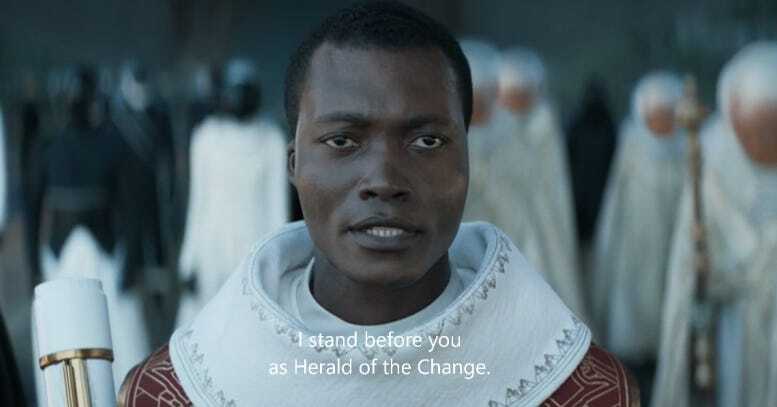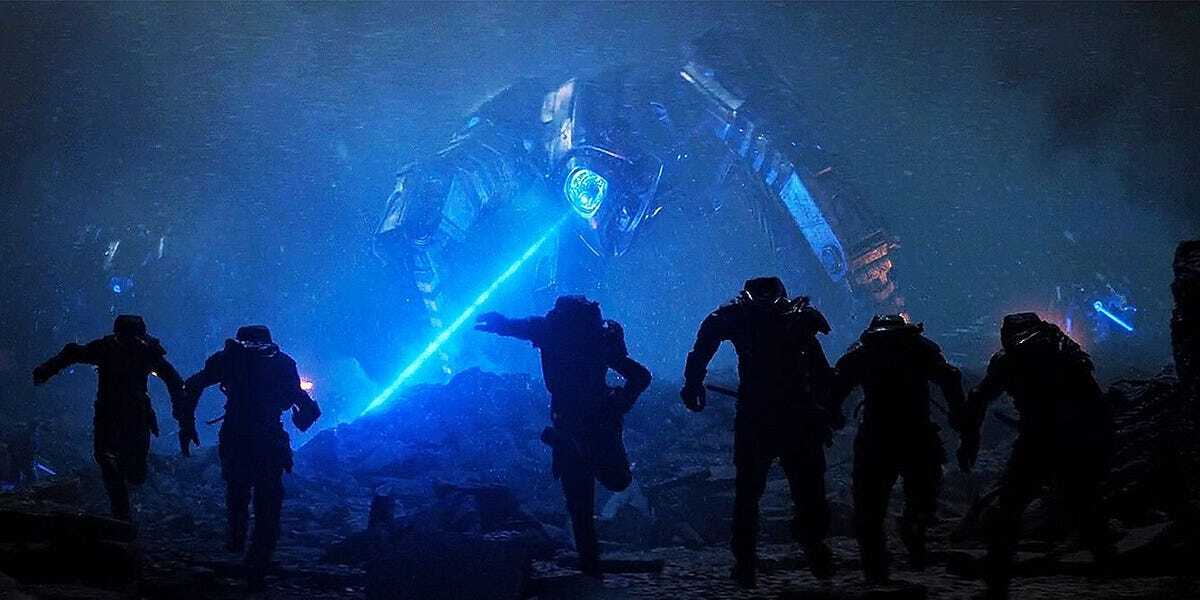
Thou shalt not make a machine in the likeness of a man's mind.
This has to be the most famous line from the Orange Catholic Bible — a commandment that remained fundamental long after the Butler Jihad.
But what actually happened during the Great Revolt?
If you've read Brian Herbert's prequels (or watched Battlestar Galactica, the Matrix, or the Terminator movies), you know the story of humanity rising up against evil robots in a drawn-out battle for survival.
If you're interested in a version of events that was still not written by Frank Herbert but was at least read by him, you might turn to the Dune Encyclopedia.
The guys over at The Dune Minute Podcast released an excellent episode just a few weeks ago.
Frank Herbert's original version, subtly implied across his six books, is much more nuanced and, surprisingly, more relevant to our present-day than any narrative of AI overlords.
As the Reverend Mother Gaius Helen Mohiam explains to a young Paul Atreides:
Once men turned their thinking over to machines in the hope that this would set them free. But that only permitted other men with machines to enslave them.
Sound familiar?
Algorithms determine what we watch, decide what we can find, and even influence how we think - the kind of control system Herbert wrote about is all around us.
I like that Frank Herbert doesn't tell us much about the details of the Great Revolt.
What really matters is not the cataclysmic event but the long shadow it cast across millennia of human development — how it fundamentally reshaped humanity's relationship with both technology and consciousness itself.
If you scratch the surface, you quickly realize that although the Jihad presents itself as a technological (and political) revolution, it was fundamentally spiritual in nature.
As the Reverend Mother Mohaim reveals to Paul, a more nuanced reading of the OC Bible's commandment would be:
Thou shalt not make a machine to counterfeit a human mind.
The focus is less on the machines and more on preserving human consciousness.
In God Emperor of Dune, Leto II elaborates on this:
The target of the Jihad was a machine-attitude as much as the machines. Humans had set those machines to usurp our sense of beauty, our necessary selfdom out of which we make living judgments. Naturally, the machines were destroyed.
So, the Jihad might've resulted in machines being destroyed and distrusted, but the catalyst for these events had to be a deeply ingrained spiritual conviction about the nature of human consciousness and its role in the universe.
This spiritual awakening is what brought about new human pursuits.
As explained by Reverend Mother Mohiam:
The Great Revolt took away a crutch. It forced human minds to develop. Schools were started to train human talents.
The Mentats became human computers, explicitly developed to replace the thinking machines. Through rigorous mental training and using sapho juice, they achieved computational and analytical abilities that could match or exceed those of the destroyed machines.
The Bene Gesserit took a different approach. Rather than trying to replicate machine computation, they focused on developing the ultimate expression of human potential through physical and mental control. Their training combined political acumen, bodily discipline, and psychological manipulation - powers no machine could replicate.
While individual humans sought to expand their consciousness, humans as a society froze into a feudalistic structure.
In Children of Dune, the mentat ghola Idaho explains it this way:
Planetary feudalism remained in constant danger from a large technical class, but the effects of the Butlerian Jihad continued as a damper on technological excesses. Ixians, Tleilaxu, and a few scattered outer planets were the only possible threat in this regard, and they were planet-vulnerable to the combined wrath of the rest of the Imperium. The Butlerian Jihad would not be undone. Mechanized warfare required a large technical class. The Atreides Imperium had channeled this force into other pursuits. No large technical class existed unwatched. And the Empire remained safely feudalist, naturally, since that was the best social form for spreading over widely dispersed wild frontiers -- new planets.
So what about the Ixians?
Operating from their underground factories, the Ixians pushed the boundaries of acceptable technology while maintaining just enough distance from true thinking machines to avoid outright violation of the Jihad's prohibitions.
They knew well that necessity would bend the law.
In God Emperor of Dune, Leto II admits to himself just as much:
I buy from them! I could not even write my journals without their dictatels to respond to my unspoken thought. Without Ix, I could not have hidden my journals and the printers.
Remember, this is the most powerful being in the known universe, who - by the way - actively maintained the Jihad's prohibitions.
And yet, he found himself dependent on Ixian innovations.
And I must continue tolerating them, Leto thought. The lxians operated in the terra incognita of creative invention which had been outlawed by the Butlerian Jihad. They made their devices in the image of the mind the very thing which had ignited the Jihad's destruction and slaughter. That was what they did on Ix and Leto could only let them continue.
The Bene Gesserit, albeit powerless, called him out on this.
"We fear anything we do not control," Anteac tells Leto II, revealing both political and philosophical concerns.
While the Sisters certainly carried an honest revulsion towards thinking machines, what they truly feared was losing their grip on human development.
Going back to dependence rather than moving forward.
It's not random that the Great Revolt is named after someone called Butler.
It's Herbert's way of acknowledging Samuel Butler, a Victorian-era author who wrote a prophetic essay called Darwin Among the Machines in 1863 that could have been the manifesto of the Dune's Jihad.
Butler warned about machines dominating humanity - not through violent uprisings but our growing dependence on them.
Day by day, however, the machines are gaining ground upon us; day by day we are becoming more subservient to them; more men are daily bound down as slaves to tend them, more men are daily devoting the energies of their whole lives to the development of mechanical life.
If you're interested in the complete text, it's free to read here.
With the omniscient "algo" and the new capabilities of "genAI" getting fully integrated into our lives, Herbert's writing feels frighteningly prescient.
So what's next? Assuming we retain (regain?) our humanity and free will?
In Chapterhouse: Dune, the tension between machines and humans presents as something new: cyborg technology to save valuable human lives.
While the prohibitions of the Jihad are on everyone's minds, an Idaho ghola suggests that we are seeing a convergence of human and machine capabilities that might transcend the old dichotomies.
But isn't this just a different kind of dependence?
You can certainly argue for and against it; the line between enhancement and surrender is certainly blurry.

.svg.png)
.png)

If you wanna chat, find me on BlueSky.
Even if you're not a supporter (yet), you can get new articles as an email as soon as they're published - full length for free stuff and a preview of the premium content.



_01563.jpg)