Never thought I'd need the word 'pharmacopoeia' - but here we are.
Because today we're gonna rummage through the Imperium's medicine cabinet - and then have some dealings with a back-alley vendor who has access to the really good stuff - to check out all the mind-altering substances of the Known Universe.
I went through all the books (core canon and expanded universe) and as is tradition in Dune, plenty of times things are described by their function: characters are popping energy capsules, greasing up blades with soporifics, downing pain killers and/or stimulants. Sometimes both.
A lot of the substances go unnamed because, just like with the guns and spaceships, the focus is on the story. We'll be skipping these mentions for obvious reasons and focusing on the drugs that do get a name and a description.
Starting with the big one.
Melange comes from the sandworm lifecycle on Arrakis. Sandtrout larvae encapsulate water deep underground, and their metabolic excretions combine with this trapped water to form pre-spice mass. Pressure builds until the mass explodes to the surface in a spice blow. Once exposed to sun and air, the pre-spice mass becomes the most important thing in the Imperium: geriatric spice, melange.
MELANGE: the "spice of spices," the crop for which Arrakis is the unique source. The spice, chiefly noted for its geriatric qualities, is mildly addictive when taken in small quantities, severely addictive when imbibed in quantities above two grams daily per seventy kilos of body weight.
— Terminology of the Imperium, Dune [1965]
Raw melange is a heavy, rust-colored powder that smells like cinnamon.
It extends human lifespan and supercharges the immune system, making users practically immune to most diseases and even poisons. On the flip side, once get hooked, you're hooked for good: withdrawal is fatal.
Heavy users develop the Eyes of Ibad, where both the iris and sclera turn deep blue. The Encyclopedia explains this isn't just cosmetic: the blue pigment acts as a filter that enhances vision in bright sunlight by increasing contrast.
The Guild uses melange for navigation. Navigators live in sealed tanks filled with orange spice-gas, which grants them the limited prescience needed to perceive safe paths through foldspace. Prolonged exposure transforms their bodies into vaguely fish-like, non-humanoid forms.
On Arrakis, everything has Spice in it - the food, the fabrics, even the plastics. But the most popular things - probably for water discipline related reasons - are drinks.
Spice-beer provides euphoric intoxication - far beyond what alcohol can do on its own.
"Bes' damn stuff ever tas'ed," Idaho said.
— Dune [1965]
Spice-coffee and melange tea offer milder stimulation with the characteristic cinnamon flavor.
Spice essence is a concentrated liquid form.
And the expanded universe mentions spice wafers and spice tablets for measured dosing.
Now, of course, the Water of Life isn't processed Spice, so it's not really a derivative - but we'll keep it here because, like Spice, it's "produced" by a sandworm.
And when I say produced, I mean it's the bitter-smelling, toxic bile of a drowning sandworm and in its raw form, it's absolutely lethal.
Reverend Mothers can use their metabolic control to transmute the poison within themselves, not only neutralizing the lethal properties but creating a powerfully psychoactive liquid.
For Reverend Mothers, it enables limited telepathy and greater access to Other Memory.
For the Fremen, the converted Water of Life becomes the tau drug used in sietch orgies.
TAU, THE: in Fremen terminology, that oneness of a sietch community enhanced by spice diet and especially the tau orgy of oneness elicited by drinking the Water of Life.
— Terminology of the Imperium, Dune [1965]
The Encyclopedia explains that this creates "heightened awareness of one another's thoughts and emotions," binding the tribe together.
An addition in Heretics of Dune, meloxy is a "spice oxidant" in common use on Rakis, affordable even by the poorest, used to counter the effects of intoxicants.
In the expanded universe, the Tleilaxu tried to break Arrakis's monopoly way before Leto II.
Project Amal produced "ajidamal," which seemed chemically identical to natural spice but proved unstable and dangerous. Test sandtrout exploded on contact and when a Guild Navigator attempted to use it for foldspace travel, both he and his heighliner passengers died.
The expanded universe describes how Ajidica, the project's creator, consumed large quantities of his creation, experiencing "pleasantly warm feelings" and "hyperconsciousness" before the flawed spice consumed his body from within.
It's not until the time of Heretics of Dune, that the Tleilaxu had indeed succeeded in producing functional synthetic spice with their axlotl tanks, breaking Arrakis's monopoly.
Core Canon purists, please take a seat before continuing. It'll just take a paragraph.
The expanded universe's ultraspice is created by genetically engineered aquatic versions of the sandworms (aka seaworms). It appears as a bluish-purple lump of soft liverlike material with a rich oily-cinnamon odor - this uniquely powerful substance is so concentrated that even small doses could trap a potential Kwisatz Haderach in a permanent catatonic state.
There, it's done. I know some of you will need it, so we're moving on to other drugs now.

Semuta is one of two drugs made from elacca wood, found on the planet Ecaz.
SEMUTA: the second narcotic derivative (by crystal extraction) from burned residue of elacca wood. The effect (described as timeless, sustained ecstasy) is elicited by certain atonal vibrations referred to as semuta music.
— Terminology of the Imperium, Dune [1965]
Users become completely withdrawn from reality.
Semuta music wailed from the strings. As though drawn by the sound, a young woman in a blue robe emerged from a doorway behind the musician. Narcotic dullness filled her eyes which were the total blue of the Ibad. She was a Fremen, addicted to the spice, and now caught by an offworld vice. Her awareness lay deep within the semuta, lost somewhere and riding the ecstasy of the music.
— Dune: Messiah [1969]
The Encyclopedia notes that soldiers under semuta influence "showed no dismay at dying," and a single dose often caused severe physiological addiction.
By the time of Paul's story, it was considered one of the Imperium's most serious health problems. Production eventually ceased due to a botanical plague affecting elacca wood and harsh anti-addiction policies.
The expanded universe shows semuta appearing throughout the history of the Imperium. In the Legends trilogy, it's described as helping users "forget a destructive past" while the Caladan trilogy mentions semuta music with "drug-infused smoke" in recreational settings.
The "perfume" mentioned by the Encyclopedia comes from Rosa osmyrrah, the "Green Perfume Flower." The sterilized blooms decompose with an exquisite fragrance that triggers purely pleasurable sensory experiences.
This mild psychomimetic overwhelms olfactory nerves, causing the brain to interpret "indescribably pleasurable smells."
The Legends of Dune trilogy includes this crunchy "rolled slip" that, when ingested, makes its users feel "tingly, calm, and distant."
A substance derived from barra ferns on Caladan, introduced in the Caladan trilogy.
In its traditional form it provides "peace and clarity" with mild euphoric effects. It's described as an addictive narcotic that saps strength, but can be modified for maximum addictive pleasure.
Now, sadly, the "enhanced" strain of the "Caladan drug" became quite deadly, tarnishing Duke Leto's reputation.
The Juice of Sapho is extracted from barrier roots of Ecaz - specifically roots growing in atomic blast zones or areas heavy with decomposed organic matter, according to the Encyclopedia.

The Terminology of the Imperium explains that it's "commonly used by Mentats who claim it amplifies mental powers." The word "claim" would suggest that the effects might be psychosomatic rather than pharmacological.
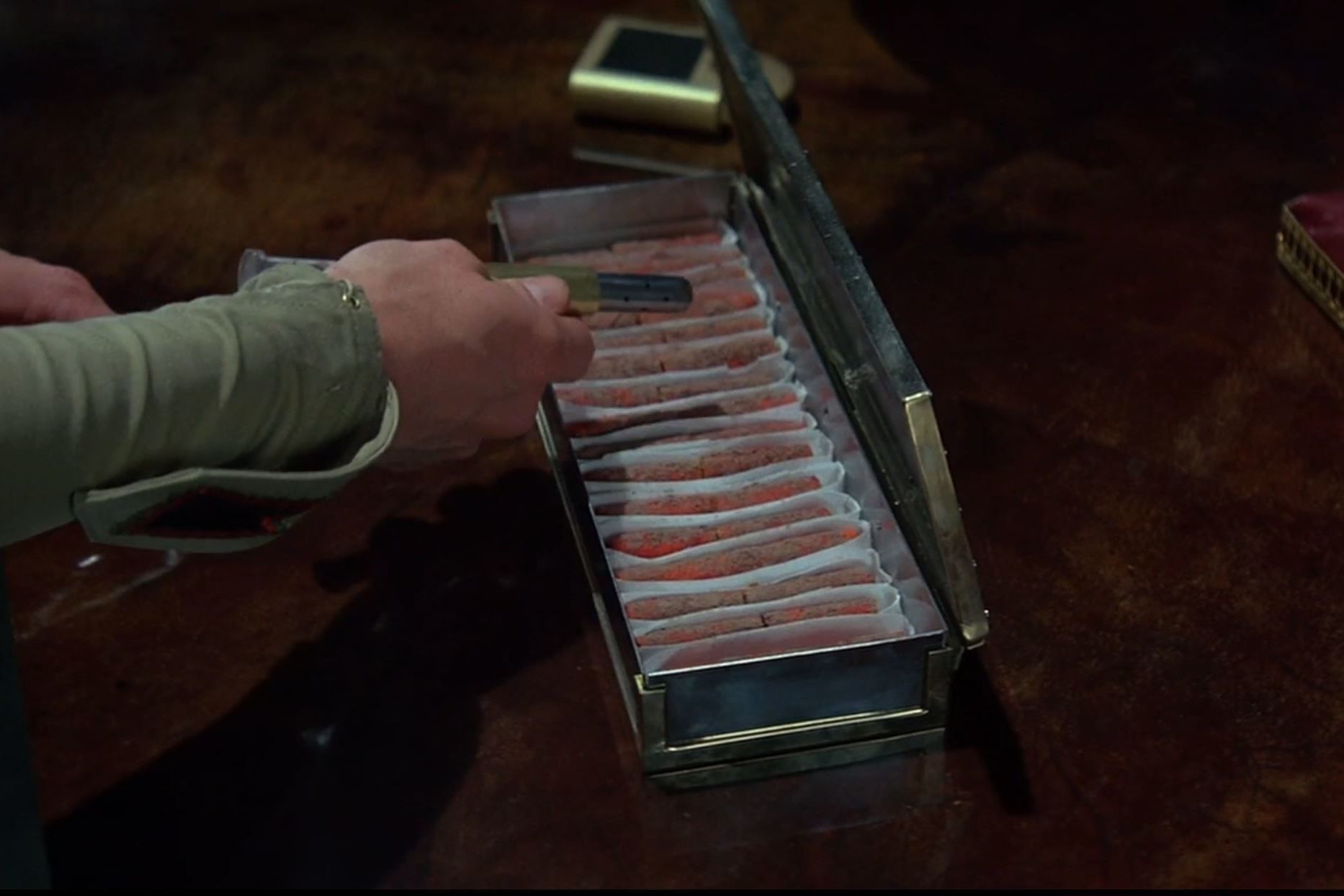
Either way, a clear sign of someone on the sapho is their lips stained a deep cranberry red.
The Encyclopedia actually provides some details about this claim, stating that experiments with untrained subjects showed no corresponding amplification of Mentat abilities, which suggests that the drug only works in conjunction with proper conditioning.
The Prelude to Dune trilogy mentions Tikopia syrup as another mind-enhancing drug used by Piter de Vries in his self-administered regimen for improved mental clarity and processing.
This would mean that poor Piter had a tripple addiction to Sapho, Tikopia and Spice. And who knows what else…
A caffeine-type stimulant from the yellow berries of akarso - a plant characterized by almost oblong leaves with green and white stripes, native to the planet Sikun.
Halleck led the file of men into the room, the staff officers looking grimly serious followed by the younger aides and specialists, an air of eagerness among them. Brief scuffing sounds echoed around the room as the men took seats. A faint smell of rachag stimulant wafted down the table.
— Dune [1965]
Another stimulant, this time from Geidi Prime, described as a bitter herb, a genetically modified blood strengthener.
The second substance produced from Elacca wood.
ELACCA DRUG: narcotic formed by burning blood-grained elacca wood of Ecas. Its effect is to remove most of the will to self-preservation. Druggee skin shows a characteristic carrot color. Commonly used to prepare slave gladiators for the ring.
— Terminology of the Imperium, Dune [1965]
The Encyclopedia talks about its application as a chemical weapon: if one could contaminate the enemy's water supplies, their forces would engage in reckless, suicidal behavior.
Verite is yet another drug from the planet Ecaz.
It's derived from the "Truthtree" (the Encyclopedia's scientific classification names it Isoetes certus) and renders users "incapable of falsehood."
The Encyclopedia notes it briefly gaining popularity at noble parties until everyone realized the effects were exactly as advertised.
After that, they used it only for interrogations.
Mentioned only twice: once in Messiah and once in Children, it's implied that it's an anesthetic injection, powerful enough to put Alia and Leto II to sleep.
Shere blocks memory probes by making subjects "totally dead" to scanning technology.
In Heretics and Chapterhouse, Shere is administered through organic implants that meter precise doses. Characters must "saturate themselves with shere" to prevent Face Dancer infiltration and memory extraction.
The Honored Matres returned from the Scattering with their own combat enhancement: an adrenaline-based compound that turns users' eyes orange (instead of blue) and provides superhuman speed, enhanced reflexes, and increased aggression.
Unlike Spice, this substance provides no prescience or access to ancestral memories - "only" enhanced physical abilities. The expanded universe suggests this stimulant might derive from the failed Tleilaxu "Project Amal."
A drug from the Prelude to Dune trilogy, delivered in yellow ampoules and causing paralysis.
No surprise, Rabban was a big fan of administering this to his victims.
It's noted that high doses can induce hibernation comas, reducing breathing and bodily needs "to the fringes of death," potentially allowing someone to survive while hidden.
Before discovering spice, the Sisterhood used other "awareness spectrum narcotics" to create Reverend Mothers and induce truthtrances.
The expanded universe identifies this original substance as coming from the planet Rossak. The same poison, it would seem, that Zensunni Reverend Mothers used to unlock their maternal genetic memory.
Some of these substances were used to induce the "truthtrance," a state of heightened perception that allowed a trained Bene Gesserit to unerringly detect falsehood. The Encyclopedia notes these preparations were "entirely benign to Truthsayers but could be fatal for anyone else attempting to use them."
And while there are alternatives, nothing beats Spice. In Paul's words: "There are other poisons the Reverend Mothers can use for their tricks, but once they've used the spice liquor, the others no longer work."
The Encyclopedia details the "herbs of consolation" - including black mullein, henbane, and belladonna - as humanity's earliest experiments with consciousness alteration.
These "poisons that also healed, soothed, and pacified" helped sorceresses take on the role of divinely inspired priestesses.

.svg.png)
.png)

If you wanna chat, find me on BlueSky.
Even if you're not a supporter (yet), you can get new articles as an email as soon as they're published - full length for free stuff and a preview of the premium content.


_01563.jpg)