
Similar to The Voice, the Coda has become synonymous with the Sisterhood.

If it's not a word you'd use on a daily basis, a coda (in our world) is a concluding section or part, serving as a summation of preceding themes, motifs, etc., as in a work of literature, drama, or even music.
In Dune, it is more commonly referred to as a document outlining the philosophy, wisdom, and worldview of the Bene Gesserit.
A foundational piece of text.
Given this, I was shocked to find only 14 quotes in Frank Herbert's six books, the Dune Encyclopedia, and Brian Herbert and Kevin J. Anderson's twenty books - with eleven of the fourteen quotes found in the last book of the original series, Chapterhouse: Dune.
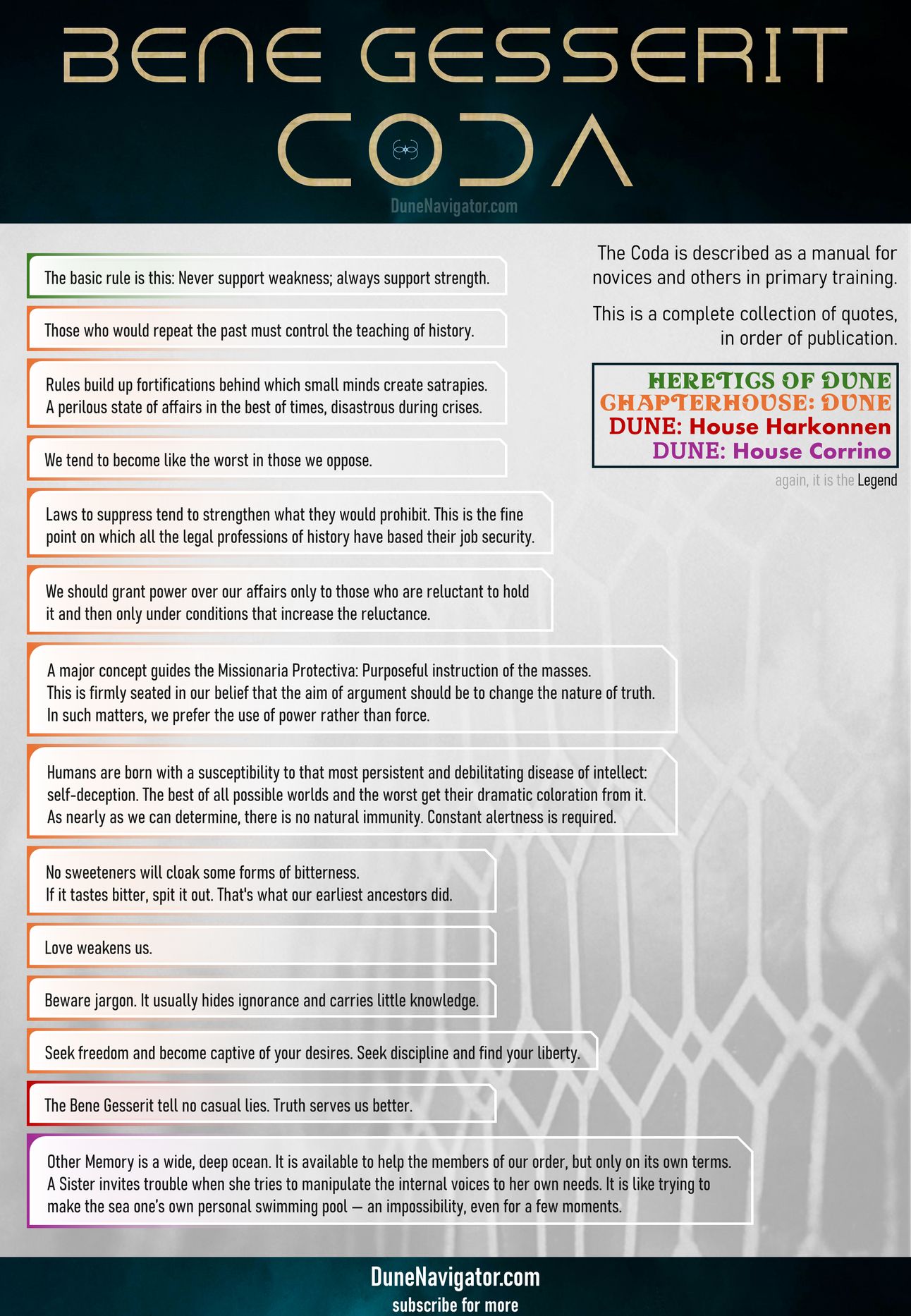
Introduced in Heretics of Dune (the fifth book, published in 1984), the Coda is first mentioned by Reverend Mother Odrade as she remembers a Van Gogh painting.
Some of the fire that had gone into the work of art inspired Odrade now. Wild inspiration! That was the message from the mad Van Gogh. Chaos brought into magnificent order. Was that not part of the Sisterhood's coda?
The Coda is initially implied to be a collection of principles that guide the actions and beliefs of the Bene Gesserit.
A secret, foundational document that contains the distilled wisdom of millennia.
And while Chapterhouse: Dune (the sixth and final book, published in 1985) is punctuated with quotes from the text, we also learn that it's actually just a Bene Gesserit 101 textbook for newcomers.
"Mother Superior, I've been searching in my manuals for an explanation of --"
"Beware of manuals!" How many times in her life had she heard or spoken those words? "Manuals create habits."
[…]
"Then why do we have manuals, Mother Superior?"
"We have them mainly to disprove them. The Coda is for novices and others in primary training."
"And the histories?"
"Never ignore the banality of recorded histories. As a Reverend Mother, you will relearn history in each new moment."
"Truth is an empty cup." Very proud of her remembered aphorism.
While it is not a book of revelations, it is still a foundational text that guides the acolytes as they take their first steps in the Bene Gesserit order.
After all of this, it will come as no surprise that the cornerstone of their worldview is pragmatism.
The emphasis on power, manipulation, and the strategic use of force, even at the expense of conventional morality, strongly aligns with the principles of Realpolitik.
The quotes echo Machiavelli's ideas, particularly the focus on maintaining power and achieving desired outcomes regardless of ethical considerations.
The Bene Gesserit understand that sometimes pragmatic, even ruthless, action is necessary.
#theendsjustifythemeans
"What ends?" - you ask.
Although they might've focused on their own survival during the rule of Leto II, ultimately, their goal is the survival and betterment of humankind.
To quote Mother Superior Odrade:
The very essence of the Bene Gesserit was concealed in loves. Why else minister to those unspoken needs humanity always carried? Why else work for the perfectibility of humankind?
Now, whether you trust these "scheming witches" or agree with their interpretation of "betterment" is a whole different story.
I have always been a big fan of the Coda.
It provides commentary on Dune's broader themes, such as the nature of humanity, (political) power, and the importance of human agency.
For the Bene Gesserit, it encompasses their ends-justify-the-means pragmatism - which extends to the Coda itself as they remain cautious that the document doesn't become dogma.
"[…] Oh, they have a Coda but it's just a collection of reminders, sometimes useful, sometimes to be discarded. They always adjust their Coda to current requirements."
It must adapt to changing circumstances.
As do we all.

.svg.png)
.png)

If you wanna chat, find me on BlueSky.
Even if you're not a supporter (yet), you can get new articles as an email as soon as they're published - full length for free stuff and a preview of the premium content.



_00038.jpg)