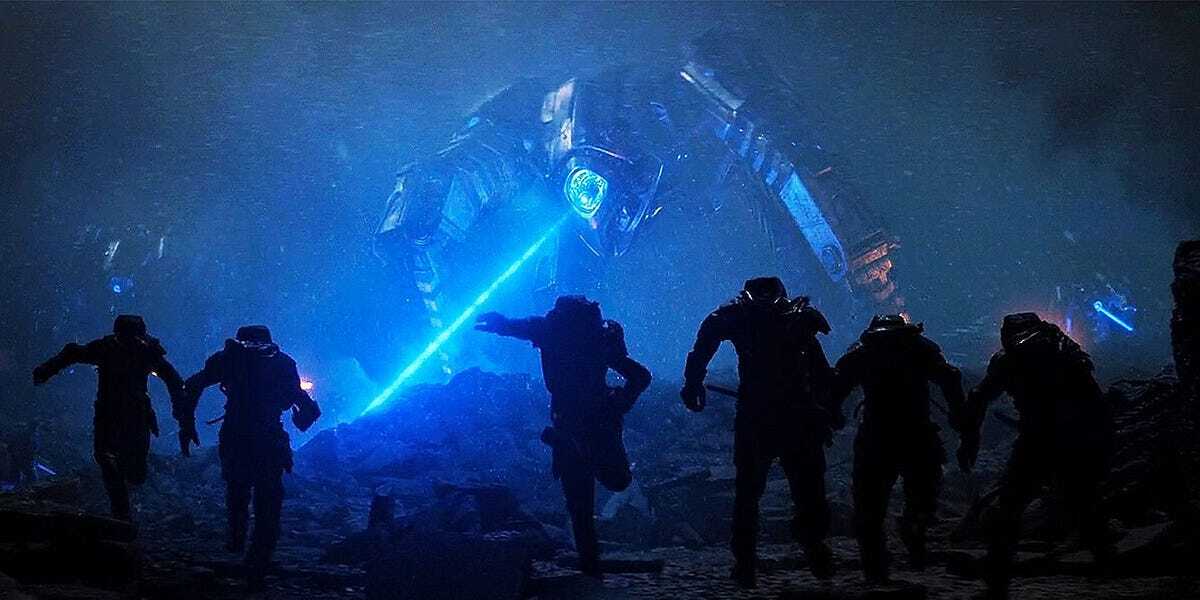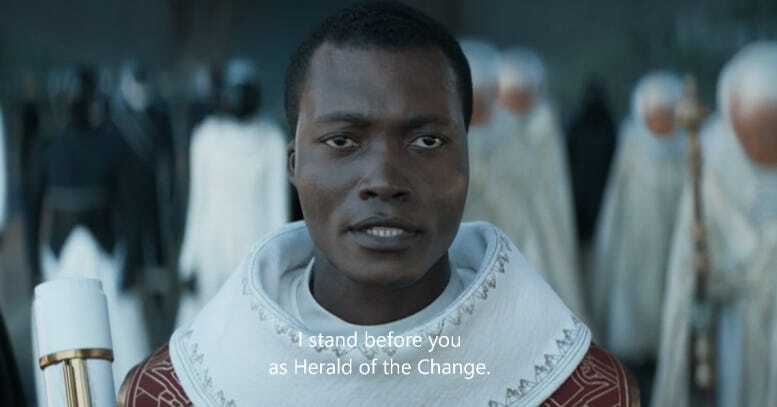
"The forms must be obeyed..."
For ten thousand years, these five words kept the galaxy from tearing itself apart.
Well, those five, and the others that were in the Great Convention. But those five were special because, apparently, that's how every rule started in that galactic version of the Constitution that governed the relations between the Great Houses of the Landsraad.
And while it's mentioned in nearly every Dune book, I doubt many people know more about it than its prohibition against atomics.
Thankfully, there's a good amount of additional details - even if it's scattered throughout the original six novels, the Dune Encyclopedia, and the Expanded Universe.
For this week's edition, I aimed at a comprehensive summary while obeying the forms of keeping the three canons separate for the benefit of the many purists among you.
According to the Terminology of the Imperium (the glossary at the back of the original Dune), the Great Convention was
the universal truce enforced under the power balance maintained by the Guild, the Great Houses, and the Imperium. Its chief rule prohibits the use of atomic weapons against human targets. Each rule of the Great Convention begins: "The forms must be obeyed…."
— Dune [1965]
This tripod of power - Guild, Houses, and Emperor - kept everyone in check since the Butlerian Jihad through a delicate balance, as explained by Paul:
"What do the Great Houses of the Landsraad fear most? They fear most what is happening here right now on Arrakis—the Sardaukar picking them off one by one. That's why there is a Landsraad. This is the glue of the Great Convention. Only in union do they match the Imperial forces."
— Dune [1965]
Basically, it was the Great Houses' insurance policy against getting Sardaukar'd into oblivion one at a time.
But it wasn't just about protection - it also laid out the rules for how Houses could fight each other without burning whole planets to the ground.
Among these regulated forms of violence were the practices of kanly (vendetta) and the War of Assassins.
The idea was simple: when nobility got stabby with each other, the damage would stay contained. No civilian massacres, no economic disruption, just targeted aristocratic murder.
So very civilized.
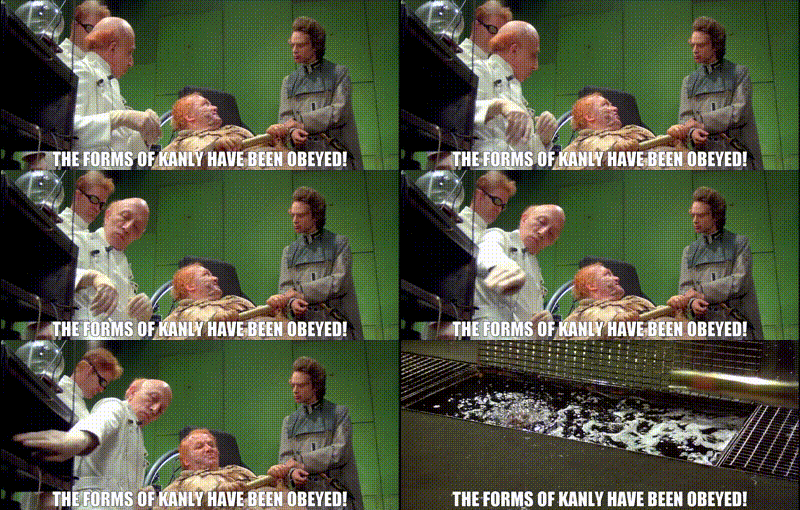
The most repeated and, thus, most famous part of the Great Convention is its prohibition against using atomic weapons on human targets.
The rule was so fundamental that even during a conflict as bitter as the one between the Atreides and the Harkonnen, Thufir Hawat completely dismissed the possibility of any form of atomics when talking to Jessica:
"There is no traitor," she said. "The threat's something else. Perhaps it has to do with the lasguns. Perhaps they'll risk secreting a few lasguns with timing mechanisms aimed at house shields. Perhaps they'll…."
"And who could tell after the blast if the explosion wasn't atomic?" he asked. "No, my Lady. They'll not risk anything that illegal. Radiation lingers. The evidence is hard to erase. No. They'll observe most of the forms. It has to be a traitor."
— Dune [1965]
"Most of the forms" - reveals early on how the Great Houses approached the Convention. What mattered was not necessarily adhering to its spirit but maintaining the appearance of compliance.
And it's a lesson Paul must've learned early on because it's the exact argument he makes when deciding to use atomics to breach the Shield Wall on Arrakis.
When Gurney Halleck objects, Paul makes a crucial distinction:
"The injunction! It's fear, not the injunction that keeps the Houses from hurling atomics against each other. The language of the Great Convention is clear enough: 'Use of atomics against humans shall be cause for planetary obliteration.' We're going to blast the Shield Wall, not humans."
— Dune [1965]
And when the Emperor confronts him, accusing Paul of violating the Convention, he maintains his point of view:
"I used atomics against a natural feature of the desert. It was in my way and I was in a hurry to get to you, Majesty."
— Dune [1965]
Cheeky.
Then again, it wasn't up to either of them to make the distinction. The prohibition wasn't maintained by a central authority but by mutual self-interest and the threat of collective retaliation.
When we see a stone-burner go off, Paul reflects on the implications:
Atomics. The Great Convention prohibited such weapons. Discovery of the perpetrator would bring down the combined retributive assault of the Great Houses. Old feuds would be forgotten, discarded in the face of this threat and the ancient fears it aroused.
— Dune: Messiah [1969]
The Great Convention might've banned atomics, but as we know, it also laid out an entire system for how feuding Houses could go at each others' throats - as long as they didn't bring down the whole galactic neighborhood.

The Terminology of the Imperium explains it this way:
KANLY: formal feud or vendetta under the rules of the Great Convention carried on according to the strictest limitations. (See Judge of the Change.) Originally the rules were designed to protect innocent bystanders.
WAR OF ASSASSINS: the limited form of warfare permitted under the Great Convention and the Guild Peace. The aim is to reduce involvement of innocent bystanders. Rules prescribe formal declaration of intent and restrict permissible weapons.
— Dune [1965]
It's weird how assassinations and murder become bureaucratic and almost mundane. "Oh, you want to wipe out another noble family? No problem, just file the proper paperwork and only use approved murder methods."
When Baron Harkonnen gets Duke Leto's rejection after giving up Arrakis, his Mentat Piter de Vries points out: "You made the peace gesture. The forms have been obeyed." Checkbox ticked, now back to plotting!
Later, when Jessica talks about how the family is settling in, she drops this gem:
"The Duke has sworn kanly. He will leave no Harkonnen agent alive on Arrakis, of course. And the Conventions, naturally, support him in this."
— Dune [1965]
Of course, they do.
And if there's paperwork, you know there has to be an office admin who needs to do it.
JUDGE OF THE CHANGE: an official appointed by the Landsraad High Council and the Emperor to monitor a change of fief, a kanly negotiation, or formal battle in a War of Assassins. The Judge's arbitral authority may be challenged only before the High Council with the Emperor present.
— Dune [1965]
Remember how Leto introduced Dr. Kynes to Paul?
"Son, this is the Judge of the Change, the arbiter of dispute, the man set here to see that the forms are obeyed in our assumption of power over this fief."
— Dune [1965]
So killing Kynes makes all the more sense, as he would've needed to report to the Landsraad High Council about the Harkonnen attack - the one that included Sardaukar and incriminated the Emperor.
While most people associate it with the Orange Catholic Bible, the most prominent outcome of the Butlerian Jihad appears in this document too.
In God Emperor of Dune, we see this rule explicitly connected to the Convention when Nayla reflects on a device implanted in her head:
She suspected that Ixians had fashioned the device. It had possessed some of their look. But God Himself had done this thing and she could ignore the suspicion that there might be a computer in it, that it might be prohibited by the Great Convention.
"Make no device in the likeness of the mind!"
— God Emperor of Dune [1981]
Later, when Idaho wonders why Leto II prohibits the training of mentats, he notes that "The Tleilaxu had assured him that the Great Convention remained in force and that mechanical computers were still anathema."
Beyond its political and military aspects, the Great Convention made a lot of sense from a CHOAM point of view - the Houses major being the primary shareholders.
Duke Leto explains this to Paul, revealing how economic self-interest reinforced the Convention's rules:
"Think of the Landsraad Houses that look to me for a certain amount of leadership—their unofficial spokesman. Think how they'd react if I were responsible for a serious reduction in their income. After all, one's own profits come first. The Great Convention be damned! You can't let someone pauperize you!" A harsh smile twisted the Duke's mouth. "They'd look the other way no matter what was done to me."
— Dune [1965]
To put it bluntly, the Convention's prohibitions were maintained not just by fear of mutual destruction but by the Houses' unwillingness to disrupt profits.
And so, for ten thousand years the Great Convention kept things in balance - until one of the Emperors decided to become a God.
To ensure his absolute power, Leto II not only confiscated all family atomics but banned shields throughout the Empire.
"Shields are banned throughout the Empire." Leto said. "It is a capital offense to have a shield."
"The question of shields," Moneo ventured.
Idaho thought Moneo was asking for an explanation of shields and said: "The belts develop a force field which will repel any object trying to enter at a dangerous speed. They have one major drawback. If you intersect the force field with a lasgun beam, the resultant explosion rivals that of a very large fusion bomb. Attacker and attacked go together."
Moneo only stared at Idaho, who nodded.
"I see why they were banned," Idaho said. "I presume the Great Convention against atomics is still in force and working well?"
"Working even better since we searched out all of the Family atomics and removed them to a safe place," Leto said.
— God Emperor of Dune [1981]
And while Leto eventually "stepped down," his impact on history extended to the Convention.
"This is a far different universe than the one where you were originally born," Teg said. "As it was in your day, we still have a Great Convention against atomics and the pseudoatomics of lasgun-shield interaction. We still say that sneak attacks are forbidden. There are pieces of paper scattered around to which we have put our names and we - "
"But the no-ships have changed the basis for all of those treaties," Duncan said. "I think I learned my history fairly well at the Keep.
— Heretics of Dune [1984]
Teg understood perfectly that times have changed, and while we might be sarcastic about upholding the forms, there was honor in (some of) that.
Shields had dominated the Old Empire, he knew, because of that oddly important set of words called "Great Convention." Honorable people did not misuse weapons of their feudal society. If you dishonored the Convention, your peers turned against you with united violence. More than that, there had been the intangible, "Face," that some called "Pride."
— Chapterhouse: Dune [1985]
But those times were gone. When Odrade confronts Scytale, she tells him:
"Scytale." How softly she spoke. "The Great Convention is ended. It's a new universe out there."
He tried to swallow in a dry throat. The whole concept of violence had taken on a new dimension. In the Old Empire, the Convention had guaranteed retaliation against anyone who dared burn a planet by attacking from space.
"Escalated violence, Scytale." Odrade's voice was almost a whisper. "We Scatter pods of rage."
— Chapterhouse: Dune [1985]
Which only confirms that the Great Convention didn't survive Leto II's Golden Path, leaving the post-Scattering universe without its stabilizing influence.
While I wouldn't consider it strictly canonical, it offers both a detailed history of the Great Convention and describes some of the rules, regulations, and procedures in much more detail than the few glimpses we get in Herbert's original novels.
According to the Encyclopedia, the Great Convention was ratified in 337 AG and was the product of the Great Synod, a decade-long diplomatic marathon held between 330 and 340 AG on Urbanus II.
During the prosperous centuries, the social structure of the Imperium — particularly the faufreluches, the code which preserved the rigid social classes — had passed from custom into common law. More and more, the most powerful Houses (who had the most to gain from the status quo) sought to put those traditions into written law.
— The Dune Encyclopedia [1984]
No surprise there - the powerful wanted to cement their advantage. Emperor Menemtahe II (not exactly a household name in Dune lore) backed this effort, personally supervising the talks.
After studying existing laws, the delegates generated over 7,000 agenda items and argued for seven years. Talk about a meeting running over.
But it was all worth it in the end. To quote the fictitious in-universe authors of the Encyclopedia: "Humanity had no reason to be ashamed of its handiwork."
The final document, 317 sections filling five volumes, was a masterwork of balance and careful wording. The Convention was intended to control, in most instances, and not to prohibit. Its emphasis on proper appearances — suggesting the primacy of form over substance — is pointed throughout by the words which begin every section: "The forms must be obeyed."
— The Dune Encyclopedia [1984]
The atomic weapons section alone took up "nearly half of one volume," with every possible scenario for atomic use spelled out in excruciating detail. But here's the Encyclopedia's cynical take on why:
If this were the Convention's true intent, it could have been achieved very simply: An absolute ban on all family atomics — backed by both Imperial and Great House force — could have rendered such items more dangerous to keep than their worth to the Houses justified. The atomics clause was so minutely detailed, however, because the delegates had no inclination toward nuclear disarmament; they simply wished to be certain that no less powerful House could overcome one of its betters by use of atomic power alone.
— The Dune Encyclopedia [1984]
This cynical assessment aligns well with Duke Leto's comments about economic self-interest trumping adherence to the Convention's principles.
There were only two people who thought that the Convention was just a bluff.
The most infamous case was House B'ganne in 410 AG:
Apparently not believing that the other Houses would stand by the Convention when push came to shove, Duke Quentin decided to use the B'ganne atomics to force the surrender of the planet Formannis... The obliteration of House B'ganne was the true ratification of the Great Convention.
— The Dune Encyclopedia [1984]
A second case happened in 5506 AG when "Yware, a totally mad pretender to the throne" attacked the Imperial Seat with atomics. His "hollow planetoid" home was vaporized with just "three hydrogen warheads."
The Encyclopedia expands on the details of formalities.
An outright war of assassins always required, under the Great Convention, a formal declaration of intent to be filed with the Imperial Court, the offices of the Guild, and the Secretary of the Landsraad. Imperial judges were appointed to monitor the conflict and particularly to observe any instances where innocent bystanders might be harmed.
— The Dune Encyclopedia [1984]
And of course, if you filed the proper paperwork to do some assassinations, you do need to do the actual assassination by the book - the Assassin's handbook. A kind of user manual for Great Convention-approved killing:
Originally a third-millennium compilation of information on poisons to aid professional assassins, The Assassin's Handbook was expanded in the fifth millennium (5345-5348) by a committee appointed by Emperor Kelal Djordjevich to discuss the theory and practice of legalized murder under the rules of the Great Convention and the conditions defined by the Guild Peace.
— The Dune Encyclopedia [1984]
The handbook wasn't just a how-to guide; it was a comprehensive resource:
The handbook was divided into four major parts, the first dealing with poisons — a legacy from the first version — the second with other weapons and their uses, and the third section with a discussion of strategies and odds, as well as methods of circumventing the Great Convention, and the rules of kanly.
— The Dune Encyclopedia [1984]
You read that right: "methods of circumventing the Great Convention." Even the official handbook included tips on how to bend the rules.
Having said that, it's quite perplexing that the fourth section apparently covered "professional standards and rules of prudence" - because even assassins have an ethics committee, I suppose.
Kanly could be declared only by the acting, titular head of a Great House. Any person presenting such a declaration was required to notify the Landsraad High Council and the Imperial Court, as well as the head of the House declared against, so that a Judge of the Rite could be appointed to supervise the kanly negotiations.
— The Dune Encyclopedia [1984]
The personal combat was highly ritualized, "with certain phrases being employed on each side to call the other out."
Remember this in the original Dune?
"Is the Atreides ready?" Feyd-Rautha called, using the words of the ancient kanly ritual.
Paul chose to answer him in the Fremen way: "May thy knife chip and shatter!"
— Dune [1965]
If combat wasn't chosen, kanly could be settled by the challenged House meeting terms set by the declaring House, typically including "the transfer of a fief, and of large amounts of CHOAM holdings or other valuables."
A Judge of the Rite could also impose a Ban on both Houses if their conflict threatened the Imperium, effectively forcing them to cease hostilities under threat of being declared traitors.
But even if you lost, you didn't really lose.
The name traditionally used for what may be one or more planets or star systems; the sanctuary planet for defeated Houses Major and Minor under the terms of the Great Convention; also, the secret support base of the Spacing Guild.
— The Dune Encyclopedia [1984]
Imagine that - instead of total extinction, your family gets shipped off to start over.
Pretty humane by Imperial standards.
And clever too - knowing there's a backup plan might make Houses more willing to participate in the system rather than going full rogue when cornered.
After all of this talk about how to dispose of one's enemies in the most civilized ways, it might come as a surprise that the Great Convention contained some rules that were not related to feuds and wars.
One of the Encyclopedia's most fascinating contributions is its explanation of how Houses acquired new planets in the late 3rd millennium AG.
Under the Right of Domain rulings in the Great Convention the House paying the Guildsmen for a planetary find gained dominion over that planet, conditional upon the approval of the Landsraad Council and the emperor.
— The Dune Encyclopedia [1984]
The Encyclopedia explains how the Convention didn't just regulate warfare - it micromanaged noble families' internal affairs too:
There were clauses which forbade assassination of one family member by another (a time-honored means of gaining advancement) or of any noble by one of inferior rank not recognized as an assassin.
— The Dune Encyclopedia [1984]
Unsure why "thou shalt not kill" wasn't enough.
Even more amazingly:
There was even a clause, admittedly a brief one, which gave instructions for the proper ranking of concubines within a nobleman's house.
— The Dune Encyclopedia [1984]
Yes, the Great Convention included rules for how to rank your mistresses.
Priorities, people!
This just further proves the Convention's obsession with maintaining proper form in every aspect of noble life, down to the bedroom.
The Brian Herbert and Kevin J. Anderson novels add their own spin on the Great Convention - mostly expanding on but sometimes contradicting their predecessors.
While the Encyclopedia clearly established that the Great Convention was ratified in 337 AG, we get this snippet in Hunters of Dune:
1 a.g. (approx a.d. 13,000)
Foldspace Shipping Company takes the name Spacing Guild and monopolizes space commerce, transport, and interplanetary banking.
After the horrors of the Butlerian Jihad, the Great Convention forbids all further use of atomics or biological agents against human populations.
— Hunters of Dune [2006]
Now, while I generally wouldn't advise trying to reconcile the three canons of Dune and just accept their fractured nature, in this particular case, you could argue that even the Encyclopedia mentions that "The Convention provided codification and a source of final authority for tenets which had been accepted (to a greater or lesser degree) for several centuries."
So… yeah.
And it's not just how the Convention began, but how it ended.
In the core canon, it's Leto II who brings about its end - but apparently, it was his aunt who laid the groundwork.
At a session of her Regent's Council, by unilateral decree, Alia amended the long-standing rules of the Great Convention that applied to atomics. Previously, Great Houses had been permitted to keep their warheads, which could be used only under strictly defined defensive circumstances. Henceforth, as a temporary emergency measure, no one except the Imperial Regent herself could possess such weaponry.
— The Winds of Dune [2009]
Now this one's a direct contradiction to the core canon - as we saw before, it was Leto II who "strengthened" the Great Convention by taking away everyone's nukes.
While the Encyclopedia establishes it as a massive thing (spanning five volumes) that needed a good seven years of debating, Dune: House Corrino describes it more like a single sheet of paper.
Shaddam wondered what the man thought he might do. If an Emperor ripped the document to shreds, would that not be a historical event in itself? A smile stole across his lips.
— Dune: House Corrino [2001]
Whatever its format, the document is a fake - at least by the time of Shaddam IV.
Shaddam knew, though few others did, that this "hallowed relic" was not actually the original, but was instead a clever forgery, since the original had been lost in the atomic blaze on Salusa. But it was a symbol, and people could be fanatical about such things.
— Dune: House Corrino [2001]
And I love this. It perfectly represents the mantra of "the forms must be obeyed" - the original has been long lost but we're keeping up appearances.
In the original Dune, we learned about "chaumurky" (poison in the drink) and "chaumas" (poison in the food) as general categories and the obligatory poison-snoopers above every noble's dinner table.
But apparently it couldn't be just any type of poison, that document of questionable length had a list of approved toxins. One of which was n'kee.
N'kee: Slow-acting poison that builds up in the adrenal glands; one of the most insidious toxins permitted under the accords of Guild Peace and the restrictions of the Great Convention.
— Dune: House Atreides [1999]
"The Forms must be obeyed. Our very civilization depends on this."
—from the Rules of the Great Convention, as applied to a War of Assassins, Paul of Dune [2008]
As we saw before, there are formalities to start a War of Assassins - and apparently, you need the proper phrasing to finish it.
Abiding by the rules of civilization was not a weakness. The forms must be obeyed. There were necessities, wars to end, lives to save.
"By the laws of the Great Convention, the established rules of conflict among the Landsraad," Leto intoned, "I hereby execute you in the name of peace." Vidal writhed, tried to fight back, but Leto continued, "Thus, I end this feud on Ecaz."
— Paul of Dune [2008]
The Great Convention allows you to pull rank in certain cases - you can even commandeer a Guild transport without much resistance:
"These matters extend outside the scope of normal commerce. I invoke the Rules of the Great Convention."
— Paul of Dune [2008]
The Great Convention talks a lot about war - but it also has some processes for peace. It turns out that the Emperor moonlights as a mediator - you just need to know what paperwork to submit.
"Ah, yes. But how can she contest the Emperor's decision, when he hasn't even made up his mind yet?" Shaddam asked.
Hesban tugged on one of his drooping mustaches, increasing the frown that he directed at the Crown Prince, but he refrained from scolding Shaddam for his ignorance of Imperial law. "By mutual agreement between the Federated Council of the Landsraad and House Corrino, the Emperor is required either to render immediate assistance, or convene an emergency Security Council meeting to deal with the matter. If your father does not act within the hour, the Ixian Ambassador is within his rights to convene the Council himself."
"Security Council?" Elrood grimaced and looked first to Chamberlain Hesban, then to Fenring for assistance. "What regulation is that infernal woman citing?"
"Volume thirty, section six point three, under the Great Convention."
"What does it say?"
Hesban took a deep breath. "It concerns situations of House-to-House warfare, in which an appeal to the Emperor has been made by one of the parties engaged in hostilities. The regulation was designed to prohibit Emperors from taking sides; in such matters you must act as a neutral arbiter. Neutral, yes -- but you must act."
— Dune: House Atreides [1999]
Wouldn't this have come in handy for a certain Atreides Duke when he knew he was walking into a trap laid by an Emperor?
The whole of Dune wouldn't have happened, if only Leto or Thufir would've remembered volume thirty, section six point three.
If there's one consistent theme across all the Dune canons, it's that the Great Convention was more about appearances than reality.
It begins with "The forms must be obeyed" and that's quite telling.
It doesn't say "The rules must be obeyed" or "The principles must be upheld" - just the forms. As long as you went through the proper motions, the spirit of the law was negotiable.
And I hope I don't sound too jaded when I see some parallels to our own world and the compromises, hypocrisies, and power dynamics in our own institutions.
Publicly proclaimed noble principles - operated by self-interest. The Duke Leto's words echo in my mind: "[…] one's own profits come first. The Great Convention be damned!"
The forms must be obeyed.

.svg.png)
.png)

If you wanna chat, find me on BlueSky.
Even if you're not a supporter (yet), you can get new articles as an email as soon as they're published - full length for free stuff and a preview of the premium content.


_00341.jpg)