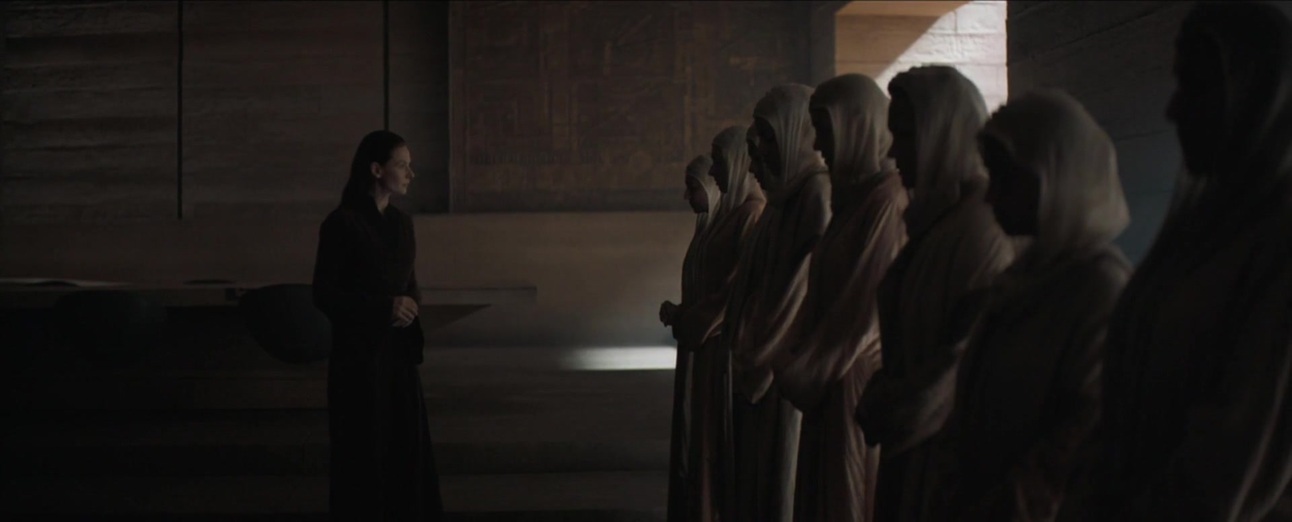
If you know the term, you know that it signifies the "rigid rule of class distinction enforced by the Imperium."
But there's so much that's weird about it.
First of all, it's this all-encompassing class (one could even call it a caste) system that apparently controls the lives of billions, if not trillions, across the known universe, but in the core canon, it only gets mentioned in Dune and Children of Dune for a total of eight times. Yes, really.
(Much of what we're gonna be talking about today is coming from the Dune Encyclopedia.)
Then, and not knowing this probably bugs me the most, we don't know where the word comes from. There are fan theories (could it really be fanfreluche?), but nothing as definitive as to earn a spot among the words we collected in Dictionary of Dune.
So just don't worry about pronouncing it wrong - we know Frank Herbert approved of fan edits. (faw-freh-loo-chez? fau-fra-loo-hes? how do you say it?)
But maybe not spelling it all out was part of the storytelling.
From what we do know, the faufreluches system was so seamlessly integrated into Imperial society that most people couldn't even see it as a system. They just saw it as the natural order of things. It was the water the fish swam in, the gravity that held the Imperium together.
Think about the letter Shaddam IV wrote to Leto when he took over Arrakis:
If the people of this decadent garrison city could only see the Emperor's private note to his "Noble Duke"—the disdainful allusions to veiled men and women: "… but what else is one to expect of barbarians whose dearest dream is to live outside the ordered security of the faufreluches?"
— Dune [1965]
The Imperial elite genuinely couldn't understand why anyone would reject their carefully ordered hierarchy. To them, faufreluches represented security, stability, I'd say even civilization itself.
Living outside the system was considered savagery.
We know this from Paul's studies of Arrakis, before moving over.
Dr. Yueh, his teacher, had hinted that the faufreluches class system was not rigidly guarded on Arrakis. The planet sheltered people who lived at the desert edge without caid or bashar to command them: will-o'-the-sand people called Fremen, marked down on no census of the Imperial Regate.
— Dune [1965]
I read this to be not unique to Arrakis but rather to any backwater world or frontier planet - places too remote or wild for proper Imperial oversight.
Which brings me to the third weird thing.
The most important planet in the known universe, the single source of spice, wasn't locked down tight? It was allowed to operate outside the rigid class system?
Then again, we know that the only deciding factor for Dune was whether the Spice was harvested in sufficient quantities.
So what exactly were the classes in the faufreluches system? As with so many of our topics, Frank Herbert was frustratingly vague about the complete hierarchy. We can piece together a few rungs on the social ladder thanks to scattered references.
Obviously, at the top we have the Padishah Emperor - although officially only one of the Great Houses, the Corrinos preside over the Landsraad and have the most CHOAM shares of all the Houses. Not to mention the Sardaukar.
Then come the other Houses Major, holding entire planets as fiefs and enough economic, political, and military power to hold each other in check / threaten each other (and occasionally the throne itself).
Below them, the Houses Minor: planetbound nobility, with limited economic power. Oftentimes entrepreneurs, serving one of the Great Houses.
Then came the specialists who made the machine-free Imperium actually function. The Mentats, living computers trained from childhood. The Bene Gesserit with their political manipulations and breeding program. Suk doctors, the Swordmasters of Ginaz, and the Guild Navigators.
And at the bottom we have working classes like bondsmen and pyons.
[Jessica] thought of calling for coffee and with the thought came that ever-present awareness of paradox in the Fremen way of life: how well they lived in these sietch caverns compared to the graben pyons; yet, how much more they endured in the open hajr of the desert than anything the Harkonnen bondsmen endured.
— Dune [1965]
PYONS: planet-bound peasants or laborers, one of the base classes under the Faufreluches. Legally; wards of the planet.
— Terminology of the Imperium, Dune [1965]
And here's what's important: the system was designed to make even the bottom rungs feel like they had dignity. Everyone had their "place," their role in the great machine.
A pyon was fulfilling their ordained function, just as essential as a Duke in their own way.
The Encyclopedia notes that "the certainty of the chance of social mobility made the restrictions of the faufreluches tolerable."
But look closely, and you'll see how all possible routes were designed to fail.
Theoretically, you could marry up. But as the Encyclopedia points out, "young women of noble birth were most often married to a nobleman of their family's choice, while noblemen were far more inclined to take an attractive commoner as concubine than as spouse."
Look at what happened to Jessica or Chani - history might call them wives, but political necessities kept them concubines.
You might be a genius entrepreneur and get as rich as any of the Great Houses but that doesn't get you political power automatically.
"Purse-nobility" - as in, titles bought with money - was "one of the deadliest insults in the Imperium." The Encyclopedia even suggests this might explain the Harkonnen desperation for legitimacy: "sources show that a case could be made for the Harkonnen titles having been acquired in this way."
The poor Baron - according to the Encyclopedia, he was fighting a ten-thousand-year-old case of impostor syndrome.
Whether it's business, war or politics, "the consent of the emperor was needed to elevate an individual, and that of both the emperor and the Landsraad to elevate a House."
In other words, you could only rise if the people above you decided to let you. And why would they voluntarily dilute their own power?
The framers of the Convention did not wish to spark discontent by making advancement impossible, but it was vital to their social system that the process be kept difficult.
— The Dune Encyclopedia [1984]
The system gave just enough hope to prevent despair, but never enough success to threaten the hierarchy.
Imperial agents cultivated a persistent pessimism among the population to bolster their power base. This pessimism acted as a psychological deterrent (in addition to religious restrictions) against technological and political innovation, keeping the empire safely feudalist for over 10,000 years.
— The Dune Encyclopedia [1984]
Sure, you had the military might of the empire to prevent outright revolts, but the primary form of control was psychological. An active effort to ensure there is no change.
The feudal pyramid must appear to all members of the Imperium as if carved in stone: no movement was easy, no revolt possible.
— The Dune Encyclopedia [1984]
It's learned helplessness on a galactic scale.
When people believe their situation is permanent and unchangeable, they stop trying to change it. They adapt instead of rebel. They find meaning in their chains rather than looking for the key.
None of this would have worked without CHOAM making it profitable.
Who held CHOAM directorships? The Emperor and the Great Houses. Who got the profits from interstellar trade? The same people. There's a great amount of self-interest in keeping the status quo.
Here's how Duke Leto explained it to Paul.
"Think of the Landsraad Houses that look to me for a certain amount of leadership—their unofficial spokesman. Think how they'd react if I were responsible for a serious reduction in their income. After all, one's own profits come first. The Great Convention be damned! You can't let someone pauperize you!" A harsh smile twisted the Duke's mouth. "They'd look the other way no matter what was done to me."
— Dune [1965]
In effect, CHOAM was responsible for the economic enforcement of the faufreluches.
Political power determined economic position, which reinforced political power, which determined economic position.
A perfectly closed loop.
And here's the biggest trick of all: the faufreluches class system didn't just control people - it made them grateful for being controlled.
Remember? "A place for every man and every man in his place."
That's a promise of security and civility. It offered identity, purpose, and the warm comfort of knowing exactly where you stood in the universe. Who needs freedom when you have meaning?
And while it's not lore-related, as I was compiling these scattered references, I found myself comparing the faufreluches to our own societies and the invisible chains they impose.
And without getting political (or pessimistic), I wonder whether the inequalities in our world are similarly made to feel inevitable - but still bearable because of a vague promise of having a chance at upward mobility.

.svg.png)
.png)

If you wanna chat, find me on BlueSky.
Even if you're not a supporter (yet), you can get new articles as an email as soon as they're published - full length for free stuff and a preview of the premium content.


_01563.jpg)