_00341.jpg)
Some of you might remember that I already had a crack at this last year, putting everything into an Airtable database and being unhappy with both the design and the functionality.
And while I’ll concede that (maaaybe) the design could still be a bit cooler, I’m happy that the new and improved Dictionary of Dune loads quickly and works exactly as I wanted it to.
As of today, there are 138 entries in the database.
Credit where credit is due: for Arabic, I relied heavily on a 2004 collection published here, and for the other 17 languages, I did my own research.
While I feel this list is pretty comprehensive, I’m certain it’s not complete, so if you find anything missing (or incorrect), please press the ‘propose an update’ button in the top right corner.
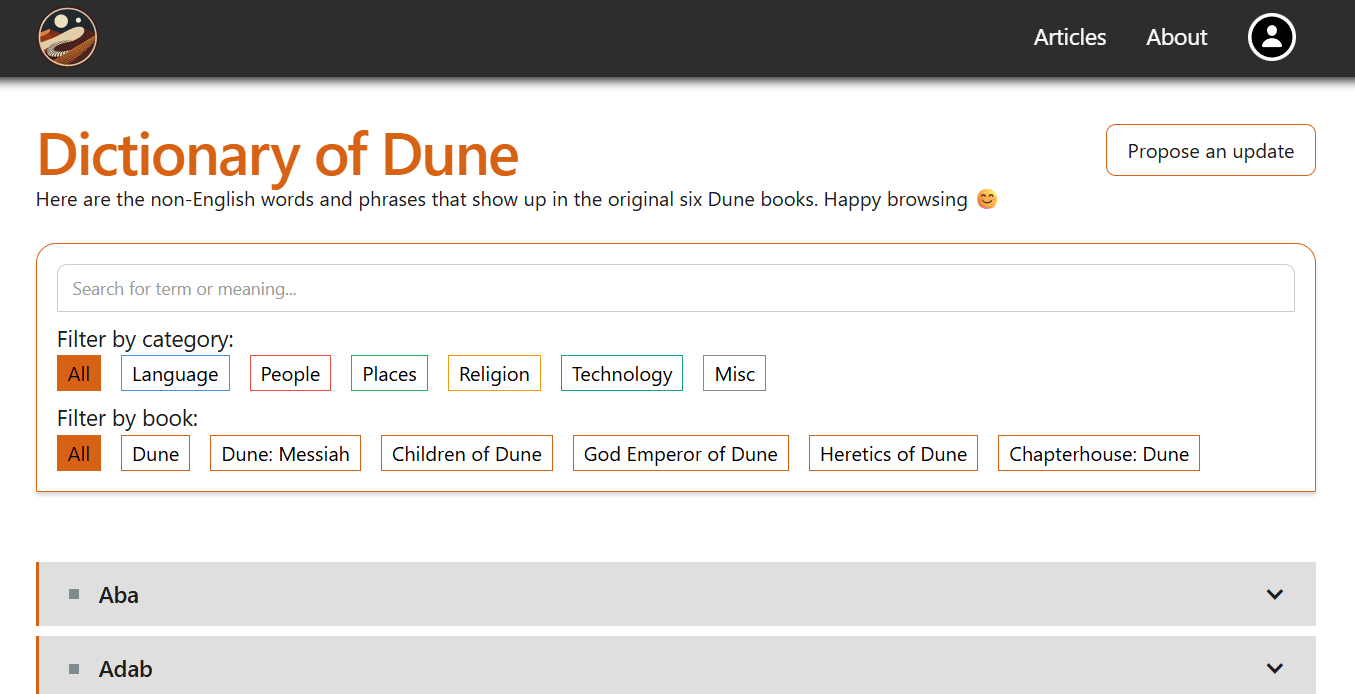
Supporters of the site also get the benefit of searching not only for phrases but also for in-universe meanings, and of filtering by category and/or book.
Speaking of categories. People, places, religion, and technology, I’ll skip over these as they are self-explanatory. I’ve grouped food, clothing, and other items into ‘misc’ since they might warrant their own category but would contain only a few words. And as for ‘language,’ that covers terms without direct English equivalents, such as ghafla, as well as words that could have been English but Herbert chose to make more exotic, like maula.
Most non-English words and phrases are related to religion. Whether it’s the Fremen with their Lisan al-Gaib and Mahdi, the Bene Gesserit with their Missionaria Protectiva and Panoplia Propheticus, or even Muad’Dib’s religion with its Quizara Tafwid, it’d have been weird if there’s no linguistic world-building happening here.
What’s perhaps more interesting (although expected) is the clear drop-off after the first book, and even more so after the original trilogy. The last three books rely largely on what came before, with only a few new additions, such as powindah, lashkar, and khasadar.
It won't come as a surprise: Arabic is, by a considerable margin, the most significant and pervasive real-world linguistic influence on the in-universe Languages of Dune.
There are over 100 Arabic terms, and, of course, most of them appear in the Fremen language. You know plenty of these by heart: Naib, Mahdi, (eyes of the) Ibad, Muad'Dib, Usul, Shai-Hulud, and Fedaykin, and the list goes on.
Herbert said he utilized "colloquial Arabic" to signal to the reader that "something of here and now has been carried to that faraway place and time." While the idea might seem dated, the use of Arabic is intended to ground the Fremen in a recognizable desert-dwelling cultural mix.
And yet, Arabic is not exclusive to the Fremen. We find it in Galach (Caid, Jihad, and Shaitan), and also in Chakobsa (Shadout), and it's used by the Bene Gesserit (gom jabbar) as well as the Bene Tleilaxu (ghola, ghufran).
It was interesting to see that most of the Persian-sourced words show up in and around the Imperial Court.
The choice seems intended to evoke Eurasian empires like the Ottoman or Safavid, lending the ruler of the Known Universe an air of ancient autocracy and distinguishing the Empire from typical Western-inspired fantasy and sci-fi.
Padishah gets us going, but then the imperial audience chamber is called a Selamlik, and it doesn't stop at Galach. Even the Fremen have a bit of Persian with their Shah-Nama, the first book of Zensunni wanderers - or as it's known on Earth, the Book of Kings.
And speaking of Fremen, the use of Yali (a waterside mansion) for a Fremen's sietch dwelling is an ironic touch - or maybe a linguistic remnant of a past aspiration.
Whether it's the long-awaited Kwisatz Haderach or arafel, the cloud-darkness at the end of the universe, Hebrew seems to be the choice of language for prophecy and mysticism.
"Do not fear the Ixians. They can make the machines, but they can no longer make arafel. I know. I was there."
— Leto II, God Emperor of Dune [1981]
While the Fremen language might have a lot of Arabic, Jamis' funeral featured a very Slavic-sounding chant.
Deep within the cave, someone began chanting:
"Ima trava okolo!
I korenja okolo!"
Jessica translated silently: "These are ashes! And these are roots!"
— Dune [1965]
The literal Serbo-Croatian means "There is grass around, and roots around," evoking the cycle of life and death.
And while you wouldn't expect it, the Fremen also seem to have had some Germanic influences.
Arrakis's graben (as in "the folk of pan and graben") refers to a sunken area, but means ditch - both in-universe and in real life.
But the best German word Herbert included, and the thing my ADHD mind most envies is… Spannungsbogen.
The Fremen were supreme in that quality the ancients called "spannungsbogen" —which is the self-imposed delay between desire for a thing and the act of reaching out to grasp that thing.
— from "The Wisdom of Muad'Dib" by the Princess Irulan, Dune [1965]
Let’s start with the obvious: the Bene Gesserit and their most famous initiative: the Missinaria Protectiva, which, of course, uses the full arsenal (pun intended) of their Panoplia Propheticus.
In imperial Galach, you find the Latin roots in words like "Mentat" and the name of the official currency, the Solari.
When it comes to Greek, you have the Atreides who claim to be the descendants of Atreus. And while that might be debatable, the origins of the ornithopter are not: it's literally the Greek words for bird and wing smushed together. Ornis for bird and pteros for wing. (Yes, it's the same for helicopter - helico meaning spiral.)
The most obvious of these might be Aztec: the Tleilaxu and their Axlotl tanks.
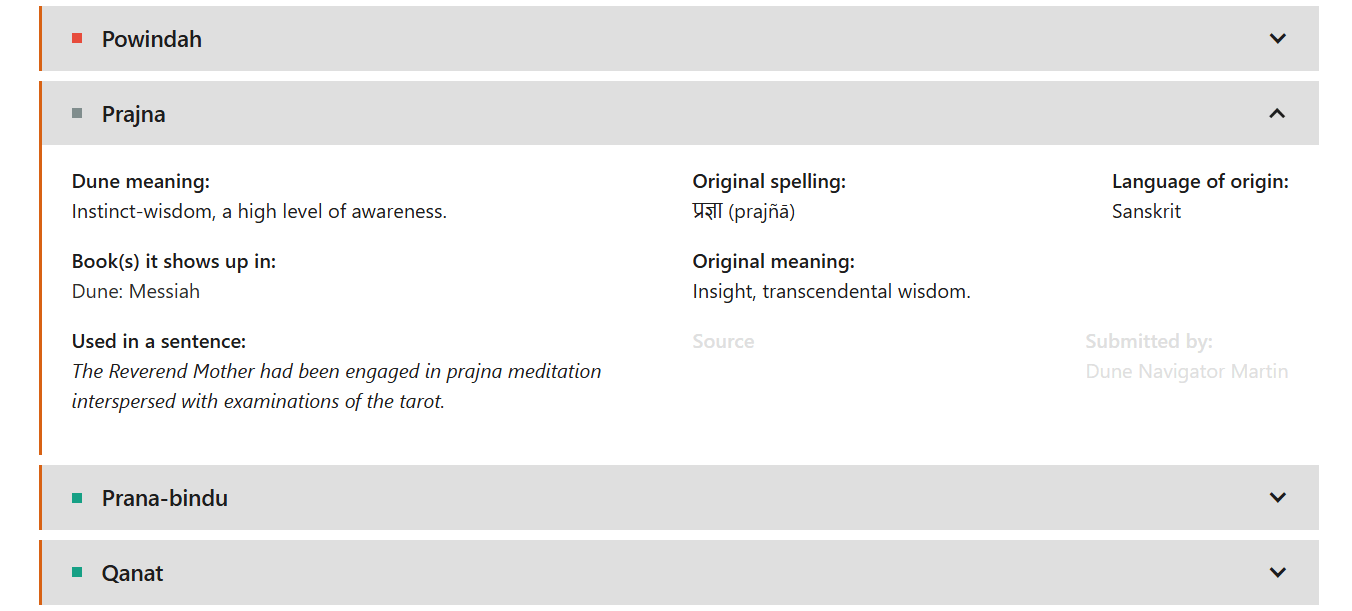
For Sanskrit, you might have guessed (correctly) prana-bindu, but it's actually used at least two more times. The more surprising of the two is the Fremen word "Sadus" for (holy) judges. Less surprising is the term prajna - similar to prana-bindu, it's a Bene Gesserit thing, a type of heightened consciousness.
And last but not least: Finnish. I did not know this before starting my research into this topic, but the family name Harkonnen has Finnish roots. Herbert reportedly found the Finnish surname Härkönen (possibly related to härkä – bull/ox) in a phone book. And while he chose it for its harsh sound, the meaning of bull is just a perfect fit, considering how the Old Duke died.
As I mentioned in the beginning, there are a total of 18 languages (so far), and you can check them all out in the Dictionary of Dune.
Hope you enjoy it.

.svg.png)
.png)

If you wanna chat, find me on BlueSky.
Even if you're not a supporter (yet), you can get new articles as an email as soon as they're published - full length for free stuff and a preview of the premium content.