
A couple of weeks ago, there was a question about Shields on the Dune subreddit, and I thought this would be the perfect time to share the article I’ve written on the topic.
Except - I had to realize - that said article did not exist. Yet.
So here we are, talking about yet another application of the Holtzman field.
Just like prana-bindu is the go-to explanation for any superhuman ability in Dune, the Holtzman effect is the thing that makes every piece of advanced Imperial technology possible.
Fold space for interstellar travel? Holtzman.
Float the Baron's rotund bulk around? Holtzman.
Stop a sword or a gun? Holtzman.
Need your spice coffee at the perfect temperature? Also Holtzman. Probably.
Herbert doesn’t just skip any kind of explanation; he’s explicit about how the Holtzman equations simply cannot be understood - even after thousands of years of research. All we know is that they work.
"Ixians have not penetrated Holzmann's unification concept," [Idaho] said. "They merely use it -- a theory that works even when you don't understand it."
— Chapterhouse: Dune [1985]
Of course, this is a recurring theme in Dune - the science bits only being there to enable the fiction.
But let’s see what crumbs of information we can gather from the six original books.
The most memorable application of shield technology is the personal shield.
When you activate one, you'll feel a "crinkled-skin tingling" at your forehead and down your back.
And if your shield comes in direct contact with another, prepare for crackling energy, electric tingles along your skin, a blue glow at the points of contact, and the sharp smell of ozone.
(If you’ve never smelled ozone in your life, it’s a very distinct smell. Personally, I’d liken it to burnt electronics but with the almost suffocating sense you get from chlorine.)

Maybe the most interesting “rule” of personal shields is that they’re only blocking fast-moving objects.
SHIELD, DEFENSIVE: the protective field produced by a Holtzman generator. This field derives from Phase One of the suspensor-nullification effect. A shield will permit entry only to objects moving at slow speeds (depending on setting, this speed ranges from six to nine centimeters per second) and can be shorted out only by a shire-sized electric field.
— Terminology of the Imperium, Dune [1965]
The shield is what makes swords relevant, and the selective permeability is what determines the style of swordfighting. Victory belongs to whoever can execute a slow, controlled thrust while their opponent is caught off-guard by feints and misdirection.
Or to those who bring specialised weapons, like the stunner.
STUNNER: slow-pellet projectile weapon throwing a poison- or drug-tipped dart. Effectiveness limited by variations in shield settings and relative motion between target and projectile.
— Terminology of the Imperium, Dune [1965]
And while fast strikes may be repelled, some kinetic energy still transfers to the wearer. A powerful enough impact could kill through blunt force trauma without ever breaching the field.
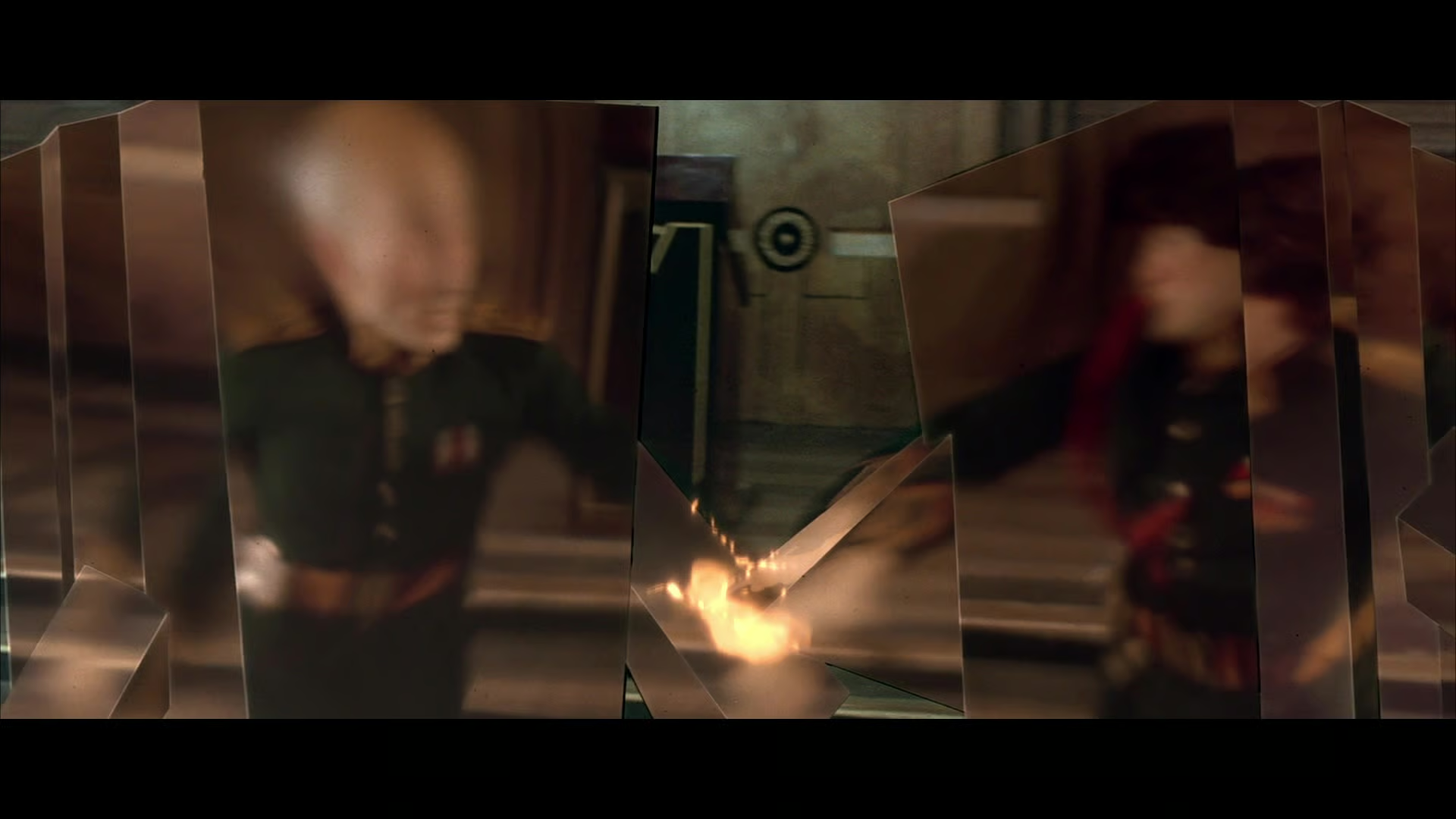
Extended combat presents its own dangers: the air inside a shield bubble can grow stale during intense fighting because oxygen consumption outpaces the slow molecular interchange at the field boundary.
The air within their shield bubbles grew stale from the demands on it that the slow interchange along barrier edges could not replenish.
— Gurney and Paul sparring, Dune [1965]
As a sidenote: this is part of the reason the Baron Harkonnen survived Leto’s assassination attempt: the Duke blew the poison cloud too fast.
He could analyze it now. His shield had been activated, set low but still enough to slow molecular interchange across the field barrier.
— The Baron Harkonnen, Dune [1965]
And this also explains why sounds take on a "shield-filtered flatness" - since air can’t move freely, sound cannot move freely either.
We’ve already mentioned how shields made regular guns irrelevant, but they’re also the reason why people don’t really use energy weapons.
Fire a lasgun at an active shield, and you get a nuclear explosion of completely unpredictable magnitude. As Jessica reflects in the first book, this explosion "could be more powerful than atomics, could kill only the gunner and his shielded target."
It's the ultimate gamble, employed only in the most desperate of circumstances.
“You planted a shield back there,” Paul said.
“A big one turned to full force,” Idaho said. “A lasgun beam touched it and….” He shrugged.
— after the battle of Arrakeen, Dune [1965]
Thousands of years later, the Honored Matres evolve this into an actual weapon system: invisible mines combining lasguns and shield generators.
Strewing the escape lanes around Lampadas with deathtraps, the Foldspace perimeter seeded with small no-globes, each containing a field projector and a lasgun to fire on contact. When the laser hit the Holzmann generator in the no-globe, a chain reaction released the nuclear energy. Bzzz into the trap field and a devastating explosion spread silently across you. Costly but efficient! Enough such explosions and even a giant Guildship would become a crippled derelict in the void.
— Chapterhouse: Dune [1985]
Although the most memorable, the personal shield is just the smallest version of the product.
One size up we have the pentashield that solves the problem of semi-permeability, and thanks to its five-layered design only allows in people who have the necessary key.
PENTASHIELD: a five-layer shield-generator field suitable for small areas such as doorways or passages (large reinforcing shields become increasingly unstable with each successive layer) and virtually impassable to anyone not wearing a dissembler tuned to the shield codes.
PRUDENCE DOOR or PRUDENCE BARRIER (idiomatically: pru-door or pru-barrier): any pentashield situated for the escape of selected persons under conditions of pursuit.
— Terminology of the Imperium, Dune [1965]
But of course, having your doorways secured doesn’t mean much if your walls can be penetrated. If you’re worried about that, you might want to upgrade to House Shields that envelope the whole of your domicile. You know, like the ones that Dr. Yueh sabotaged before the battle of Arrakeen.
And if you ever need to leave the protection of your home, you can always rely on shielded vehicles - thopters, for example.
“These ‘thopters are fairly conventional,” Hawat said. “Major modifications give them extended range. Extra care has been used in sealing essential areas against sand and dust. Only about one in thirty is shielded—possibly discarding the shield generator’s weight for greater range.”
— Hawat’s briefing on available equipment, Dune [1965]
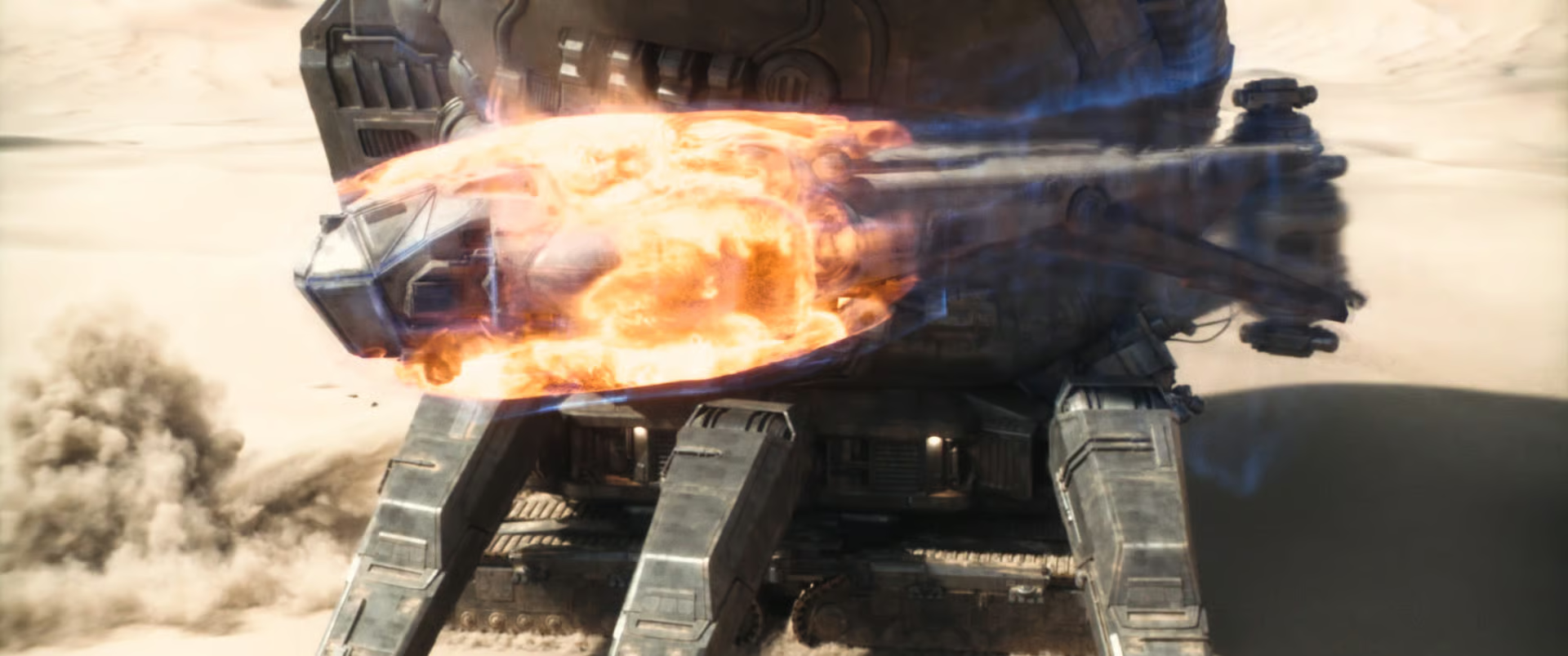
And finally, starship shields are implied but never actually mentioned.
As part of his plan to bring about the Golden Path, Leto II (the second) banned not only atomics, but also shields. (And also Mentats.)
“Shields are banned throughout the Empire.” Leto said. “It is a capital offense to have a shield.”
— God Emperor of Dune [1981]
Officially, this was to uphold the Great Convention completely and ensure that shield-lasgun explosions don’t threaten the Empire, but in reality he was disrupting the stale(mate of) military powers across the Known Universe.
And the ban took: by the time of Heretics it’s more of a curiosity.
"Shields of that type have almost gone out of fashion," Teg said. "A few societies maintain them as a kind of sport but otherwise "
— Heretics of Dune [1984]

.svg.png)
.png)

If you wanna chat, find me on BlueSky.
Even if you're not a supporter (yet), you can get new articles as an email as soon as they're published - full length for free stuff and a preview of the premium content.