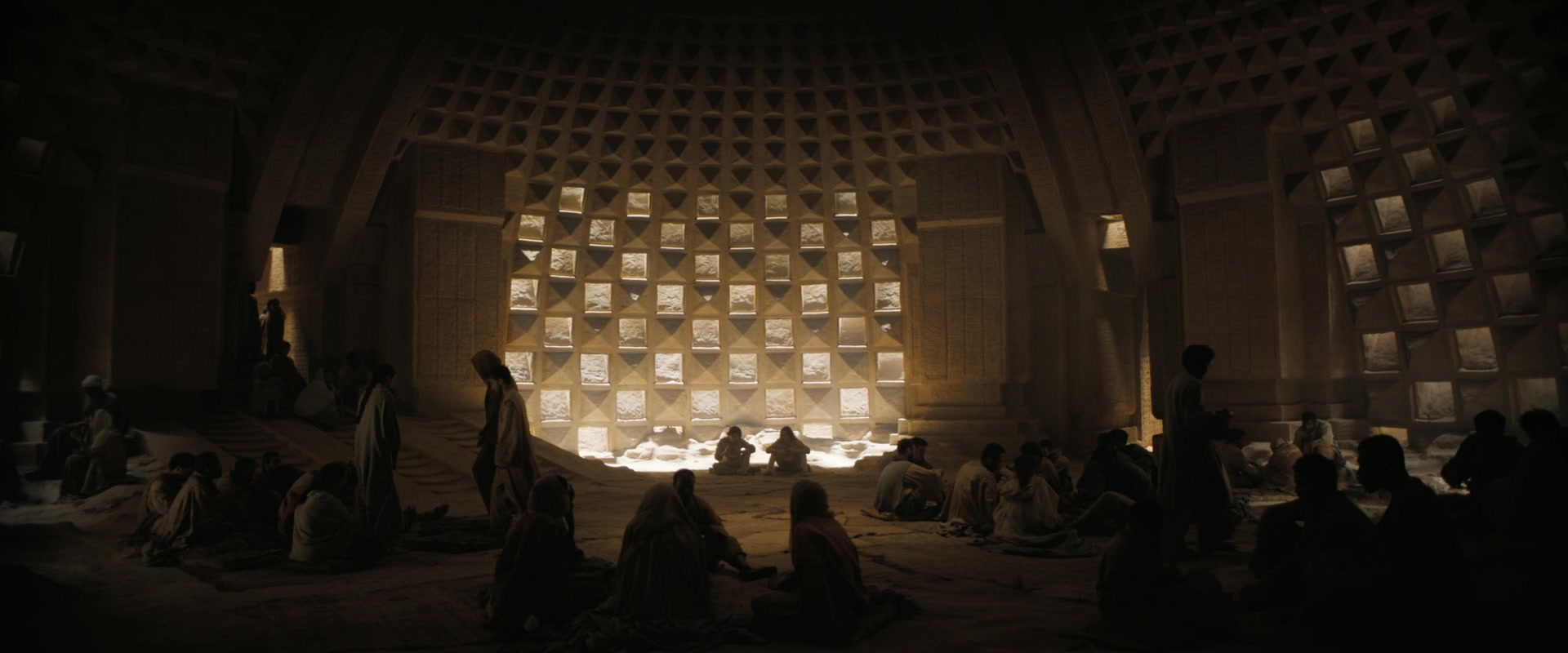
The Orange Catholic Bible is the most interesting religious text I've never read.
It's mentioned throughout the Dune series, quoted and referenced by everyone from Gurney Halleck (all the time) to Paul Muad'Dib (some of the time).
For this newsletter, I've gone through all the Dune books (the original six, the Dune Encyclopedia, and all 19 books of the expanded universe) to compile all the quotes and background information available.

At its core, the OC Bible is what happens when a bunch of scholars lock themselves in a room for seven years and try to create one unified holy book.
It's like the ultimate religious compromise - which explains why it was immediately controversial enough to get eighteen of its creators lynched.
Created by the Commission of Ecumenical Translators (C.E.T.), the O.C. Bible pulled together elements from numerous ancient (in-universe) faiths: Maometh Saari, Mahayana Christianity, Zensunni Catholicism, and various Buddislamic traditions.
It wasn't just a copy-paste job either; they extended, abridged, and completely reorganized the canon.
See if you can spot what quote comes from what tradition.
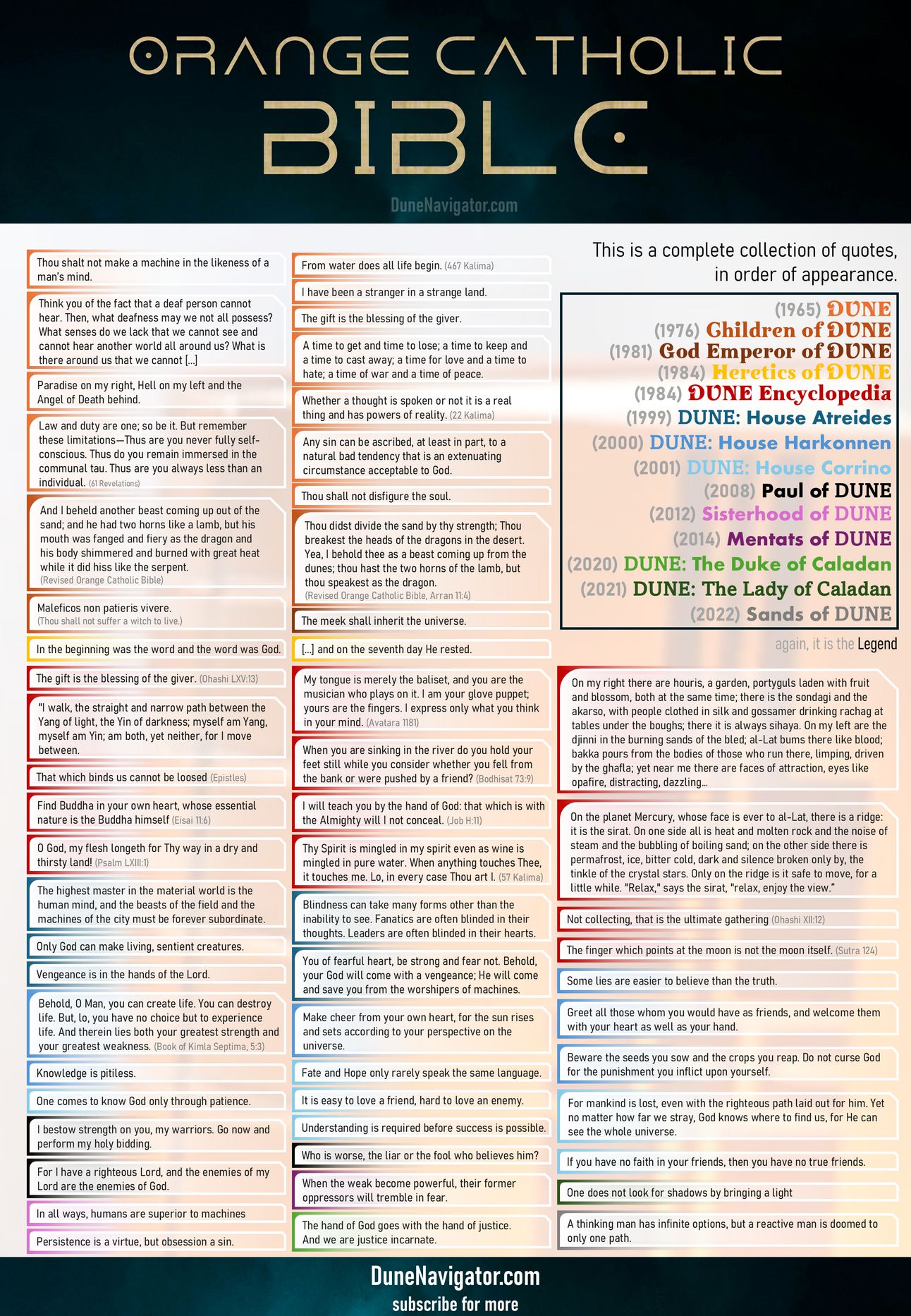
The finished product came with two companion texts: a Liturgical Manual for actual worship practices and the Commentaries - which contains some remarkably candid admissions about what the C.E.T. was really trying to accomplish.
One of my favorite bits of Dune trivia is the origin of the "Orange" in Orange Catholic Bible.
Contrary to what you might expect, it has nothing to do with the color of its cover - and of course, it has nothing to do with the fruit we know.
The Dune Encyclopedia (which presents itself as an in-universe text, compiled about 5500 years after the original book's events) reveals that by the time of Muad'Dib, the word "orange" had completely lost its connection to the citrus fruit.
In fact, what we call oranges were known only as "portyguls" in the Imperium. (Herbert took the Arabic word for oranges: برتقال - "bortoqal")
The Encyclopedia tells us that in the religious discourse of the time when the OC Bible was compiled, "orange" and "catholic" had become shorthand for innovative and rational schools of religious thought - the equivalent of our "progressive" and "orthodox."
We get glimpses of this usage in fragments of Chairman Toure Bomoko's memoirs, where he tosses around phrases like "utterly Orange is the only word to describe that nonsense" and "all of those oranges are bananas."
The man clearly had a way with words.
Of course, outside the Dune universe, there's another layer to Herbert's choice of "Orange Catholic."
In real-world history, "Orange" has strong religious connotations through its association with the Orange Order - a Protestant fraternal organization founded in 1795 and named after the Protestant King William of Orange who defeated the Catholic King James II in the 17th century.
"Orange" became deeply associated with Protestant identity, particularly in opposition to Catholicism. The Orange Order is known for its parades celebrating Protestant heritage and William's victory at the Battle of the Boyne.
So by combining "Orange" (Protestant) with "Catholic," Herbert created a religious oxymoron perfectly symbolizing the merging of historically opposed traditions.
Just as the OCB combined contradictory religious traditions, its very name embodies that same tension.
(Note: I'm focusing on the Dune Encyclopedia's telling of the events, as I consider that closer to canon. While Brian Herbert's Schools of Dune trilogy has a whole plot-line dedicated to the CET's work, the major strokes remain similar enough not to warrant a separate summary.)
The Orange Catholic Bible wasn't created in a vacuum. It emerged directly after the Butlerian Jihad - that galaxy-spanning revolt where humans decisively rejected thinking machines and AI.
After generations of chaos and the overthrow of the "god of machine-logic," humanity found itself in what's brilliantly described as a "thalamic pause" - essentially a collective moment of "ok, so now what?"
Religious leaders, whose followers had spent centuries enthusiastically fighting each other, suddenly decided to try talking instead.
This wasn't entirely their idea - both the Spacing Guild (establishing their travel monopoly) and the Bene Gesserit (who never saw a religious movement they couldn't exploit) pushed for this ecumenical gathering.
According to the Encyclopedia, the Commission of Ecumenical Translators met on an island on Old Earth - neutral ground for this unprecedented religious summit. Their first agreement was remarkably ambitious: "We are here to remove a primary weapon from the hands of disputant religions. That weapon—the claim to possession of the one and only revelation."
And then... silence. For over a year, no announcements came from the C.E.T., earning them the nickname "Old Cranks" (or more colorfully, "Cranks-Effing-Turners").
During this silence, rumors about which texts they were comparing leaked out, triggering riots that allegedly killed around 80 million people - or about 6000 per planet in the Imperium.
Nothing says "religious devotion" quite like murdering millions over committee work rumors.
After seven years, they finally unveiled their masterpiece: "Here is a work with dignity and meaning. Here is a way to make humanity aware of itself as a total creation of God."
A few dozen pages into the original Dune we encounter the first quote: "Thou shalt not make a machine in the likeness of a man's mind," which establishes the religious foundation for the Butlerian prohibition of thinking machines.
This pairs powerfully with another core principle of the book: "Thou shalt not disfigure the soul."
Just like Dune in general, the focus is on humanity.
Another concept introduced in the original Dune is "sirat," described in the OCB as the passage that portrays human life as a journey across a narrow bridge (the Sirat) with "Paradise on my right, Hell on my left, and the Angel of Death behind." A balancing act that will be required by most of our protagonists.
The OCB's perspective on sin and moral responsibility appears in Children of Dune with the quote: "Any sin can be ascribed, at least in part, to a natural bad tendency that is an extenuating circumstance acceptable to God" - suggesting a rather compassionate approach to human weakness.
And finally, in Heretics of Dune, we find echoes of Genesis with "In the beginning was the word and the word was God" and "and on the seventh day He rested."
The Dune Encyclopedia expands our understanding of the OCB tremendously, providing both context and content that the main novels only hint at.
The Encyclopedia adds to the OCB's mystical dimension with texts like: "Thy Spirit is mingled in my spirit even as wine is mingled in pure water. When anything touches Thee, it touches me. Lo, in every case Thou art I" (57 Kalima)
But it also quotes stoic-like wisdom: "When you are sinking in the river do you hold your feet still while you consider whether you fell from the bank or were pushed by a friend?" (Bodhisat 73:9)
And we get meta-awareness, seemingly hinting at the limitations of religious language itself. "The finger which points at the moon is not the moon itself" (Sutra 124)
The expanded universe novels give less mysticism and more practical ethics, with a primary focus on the relationship between humans and machines.
This quote from Dune: House Atreides feels a bit on the nose: "The highest master in the material world is the human mind, and the beasts of the field and the machines of the city must be forever subordinate."
But it also offers some leadership advice: "Blindness can take many forms other than the inability to see. Fanatics are often blinded in their thoughts. Leaders are often blinded in their hearts."
Sisterhood of Dune reinforces the anti-technology stance with "In all ways, humans are superior to machines," while also offering aphorism-sounding quotes like "Persistence is a virtue, but obsession a sin."
The most recent Dune books focus on practicalities, like: "A thinking man has infinite options, but a reactive man is doomed to only one path."
Across all the expanded universe books, we see a consistent emphasis on human supremacy over technology, the complexities of power, and the tensions around free will - themes that complement and extend the OCB's portrayal in Herbert's original works.
After seven years of hard work, when the translators returned to their congregations, eighteen were lynched within two months.
Fifty-three quickly recanted their work, presumably hoping to avoid a similar fate.
Critics called it a product of "the hubris of reason" with a "seductive interest in logic."
Revised versions appeared almost immediately, reintroducing familiar symbols and comforting traditions that people weren't ready to abandon.
Yet despite (or because of) this controversy, the OCB spread everywhere. Everyone wanted to see what the fuss was about. C.E.T. Chairman Toure Bomoko prophetically noted: "Institutions endure. Symbols endure when their meaning is lost."
And indeed, ninety generations later, the OCB had become the standard religious text of the Imperium.
By Paul's time, the OCB was so embedded in culture that even hardened warriors like Gurney Halleck quoted it regularly. Paul himself received his copy from Dr. Yueh before leaving Caladan - a gift that would subtly shape his spiritual journey in ways Yueh never intended.
When Paul joined the Fremen, he discovered surprising overlaps between their Kitab al-Ibar and the OCB. This convenient religious crossover helped him lead the Fremen by speaking their spiritual language while adding his own Imperial perspective.
Fast forward 3,500 years to the end of Leto II's reign, and the OCB was still influential; the text remained significant even as Leto systematically dismantled nearly every other power structure in human society.
By the time of Heretics of Dune, after the Scattering had sent humans across the universe, elements of the OCB were still influencing human culture on countless worlds.
Talk about a successful publication!

.svg.png)
.png)

If you wanna chat, find me on BlueSky.
Even if you're not a supporter (yet), you can get new articles as an email as soon as they're published - full length for free stuff and a preview of the premium content.