A month ago, I went all Princess Irulan on... well, Princess Irulan and created a complete database of her literary works.
Your response was incredible. And I was so happy to see that I'm not alone in enjoying a nerd approach to Dune. Thank you all. Your support certainly helped me continue down this rabbit hole.
So what began as focused research into Princess Irulan's books has now expanded into something even more ambitious.
My eyes bloodshot from squinting at endless chapter headings, it made me feel like a Mentat working without the juice of sapho… but it's done.
I've created a complete database of ALL the epigraphs from the original six Dune novels - every quote, every source, every speaker, meticulously cataloged.
And today, I'm thrilled to share the results of this labor of love.
You can find it at epigraphs.dunenavigator.com.
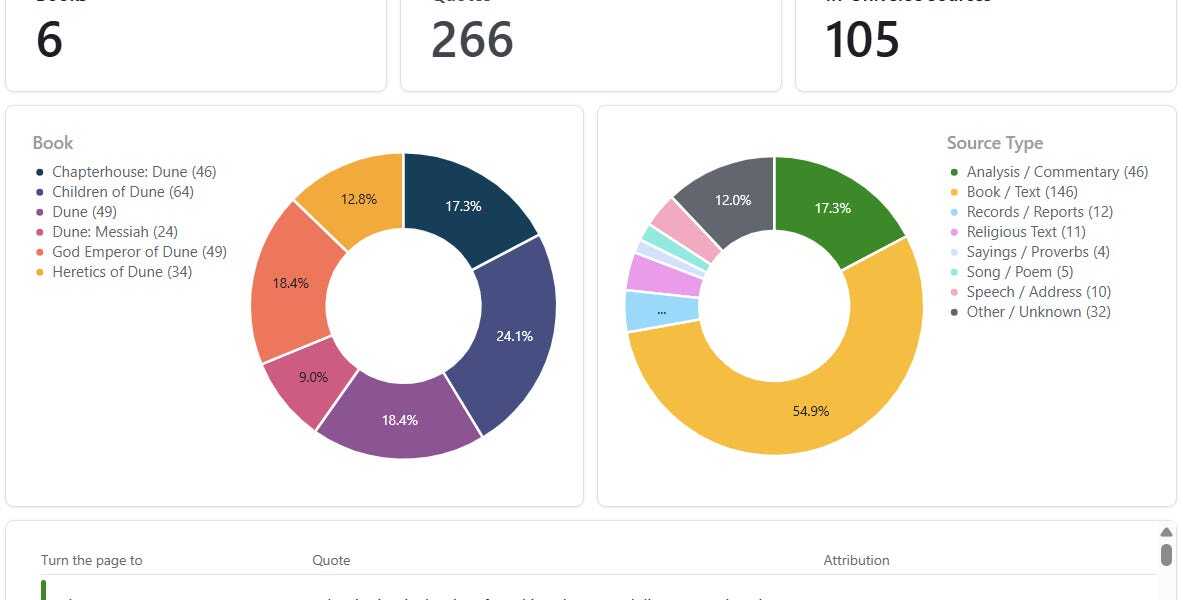
It looks like this:

I hope you have fun using it.
(This was painstakingly assembled, and I double-checked everything. Even so, there might be mistakes or errors - if you find any, please reach out.)
Before getting to the actual analysis, let's clear up some literary terminology, as I've noticed a bit of confusion in Dune communities between three similar-sounding terms:(tbh I had to google it myself just to be sure I'm using the right one)
is the thing we're talking about: a quotation at the beginning of a book, chapter, or other section that intends to suggest its theme.
is a brief, clever, and memorable statement, often with a witty or satirical twist.
Think Oscar Wilde's "I can resist everything except temptation." The Fremen have several epigrammatic sayings, like "God created Arrakis to train the faithful."
And one of the epigraphs is actually a Tleilaxu Epigram:
Here lies a toppled god --
His fall was not a small one.
We did but build his pedestal,
A narrow and a tall one.
is an inscription on a tombstone or monument in memory of the person buried there.
An example from the database that kinda fits the bill:
This rocky shrine to the skull of a ruler grants no prayers. It has become the grave of lamentations. Only the wind hears the voice of this place. The cries of night creatures and the passing wonder of two moons, all say his day has ended. No more supplicants come. The visitors have gone from the feast. How bare the pathway down this mountain.
—Lines at the Shrine of an Atreides Duke, Anon
Although Herbert certainly didn't invent epigraphs, I always felt that he used them in a really clever way. The quotes might not have always hinted at the themes of the chapter ahead, but they provided a glimpse behind the curtain, they added an additional layer of world-building, and offered the perspectives of characters who might not have been given a voice otherwise.
Ok, now that we got this out of the way… back to the fremendously nerdy stuff.
The six original Dune novels contain 274 chapters and 266 epigraphs.
The 8 chapters without openers are as follows:
Here's how the epigraphs break down by book:
Categorized by the type of in-universe source:
What was interesting to see is that some books (Dune and God Emperor of Dune in particular) had a whole theme built around their epigraphs, while others (looking at you, Messiah) were… not as focused.
More on this, a bit further down.
Each book has its own set of sources that appear nowhere else in the series:
Children of Dune stands out as having the most unique sources, reflecting the transitional nature of the book. It bridges the gap between Paul's era and Leto II's reign, incorporating voices from both periods.
The Stolen Journals dominates not only in raw numbers but in percentage - it comprises 81% of God Emperor's epigraphs. No other source comes close to this level of dominance in any book.
If you ever felt like Herbert wanted to give us direct access to Leto II's mind, now you have the numbers to back you up.
Looking at who actually speaks the words in each epigraph, independent of who captures those words:
Again, the God Emperor comes out on top - of course, this makes sense given his 3,500-year reign and the profound impact he had on the universe.
What's interesting is the shift in voices over time. In Dune, Irulan's voice appears in 22 quotes, with Paul's voice in 16. By God Emperor, Leto II speaks in 45 of the 49 epigraphs. In the final two books, the Bene Gesserit perspective (through Odrade and others) becomes increasingly prominent.
When we look at who wrote or edited the in-universe sources rather than who's being quoted, the pattern shifts slightly:
Irulan emerges as the most prolific author, which makes sense given her hobby as imperial historian. What's really interesting is that Harq al-Ada (the name taken by Farad'n as Leto's chronicler) authored as many distinct works as Irulan did.
(Sidenote: I know there are some books in the database that the Dune Encyclopedia attributes to Irulan, but for this piece, I'm sticking to the core canon only. So if Herbert didn't mention Irulan next to a title, I'm not assuming anything based on other sources.)
Poor Corrinos. Relegated to serve as scribes of Atreides emperors.
I analyzed the epigraphs for recurring themes, counting mentions of key concepts across all six books:
What's interesting is how the themes shift in emphasis from book to book:
The emphasis on ecology in Children of Dune is particularly notable, as it coincides with Leto II's transformation and his realization of the Golden Path. Similarly, the focus on war in God Emperor reflects Leto's "enforced peace" and his control of violence throughout the universe.
Because the titles keep changing, you might not have even noticed a subtle trick in the original Dune: all of the in-universe books quoted in the epigraphs are written (or edited) by the Princess Irulan.
(Sidenote: the only exception is a quote by Pardot Kynes, but that's ahead of Appendix I of the book and isn't part of the main story.)
This creates a fascinating narrative paradox. We're reading about Paul's rise to power as it happens, yet simultaneously being fed perspectives from historical accounts written years or decades later.
What's particularly clever about this approach is how it serves multiple storytelling purposes:
There's a delicious irony here, too - Irulan monopolizes the historical narrative about a man who never truly let her into his life.
And speaking of Corrino chroniclers, Herbert pulls the same trick in Children of Dune but hides Farad'n behind his pen name until the very end of the book.
I've mentioned it several times already, but "The Stolen Journals" deserves special attention. With 42 quotes, all in God Emperor of Dune, it represents the single most dominant source in the entire series.
So, why this exclusive focus on one source? I believe it serves several purposes:
The Stolen Journals are particularly fascinating because they're one of the few sources that are explicitly discussed within the main narrative. We learn that Leto deliberately wrote them in a way that would ensure they would be stolen and distributed after his death, thus fulfilling his didactic purpose even after his physical destruction.
A few epigraphs stand out for their uniqueness or significance:
Perhaps the most important function, and the reason I fell in love with the epigraphs, is how they expand the Dune universe beyond the main narrative.
They create:
They establish Dune as a world with its own academic traditions, religious texts, and historical debates. They make the universe feel lived-in.
I encourage you to explore the database - perhaps you'll discover patterns I've missed entirely. If you do, please let me know. (And again, if you find any mistakes, I'd be more than happy to correct them.)

.svg.png)
.png)

If you wanna chat, find me on BlueSky.
Even if you're not a supporter (yet), you can get new articles as an email as soon as they're published - full length for free stuff and a preview of the premium content.


_01563.jpg)