I've spent way too much time thinking about this.
Yes, there's plenty of sandworms, Duncans, and known-universe-spanning politics to obsess over, but something about these polar caps kept me up at night.
I can get behind having ice caps on a planet that's primarily desert, but what keeps nagging at me is the lack of a wet, temperate zone between the freezing cold and the sizzling hot.
Why does Arrakis cosplay as a Song of Ice and Sand?
So I did some digging. I went through the Core Canon, the Dune Encyclopedia, and the Expanded Universe, and I think I found the in-universe answer(s). (Even if actual science might not support it.)
While the original book has plenty of references to the north pole of Dune, I was shocked to discover that it's never mentioned again in any of Frank Herbert's sequels. Not once.
Was it something he wanted to sweep under the rug? Maybe it just wasn't relevant. Who knows?
The first time we get to see the ice is thanks to the Baron Harkonnen, who, of course, has an ornate globe with "polar caps [of] finest cloudmilk diamonds " in his study.
"I invite you to observe," the basso voice rumbled. "Observe closely, Piter, and you, too, Feyd-Rautha, my darling: from sixty degrees north to seventy degrees south—these exquisite ripples. Their coloring: does it not remind you of sweet caramels? And nowhere do you see blue of lakes or rivers or seas. And these lovely polar caps—so small. Could anyone mistake this place? Arrakis! Truly unique. A superb setting for a unique victory."
— Dune [1965]
And while you might not have a fancy globe, if you keep reading your copy of Dune past the appendices, you'll eventually get to the map of the northern hemisphere and some cartographic notes.
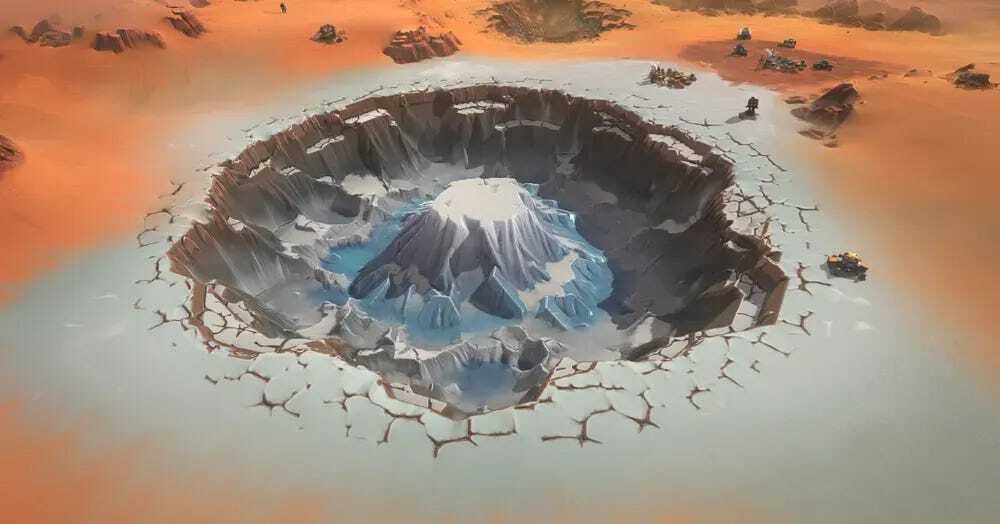
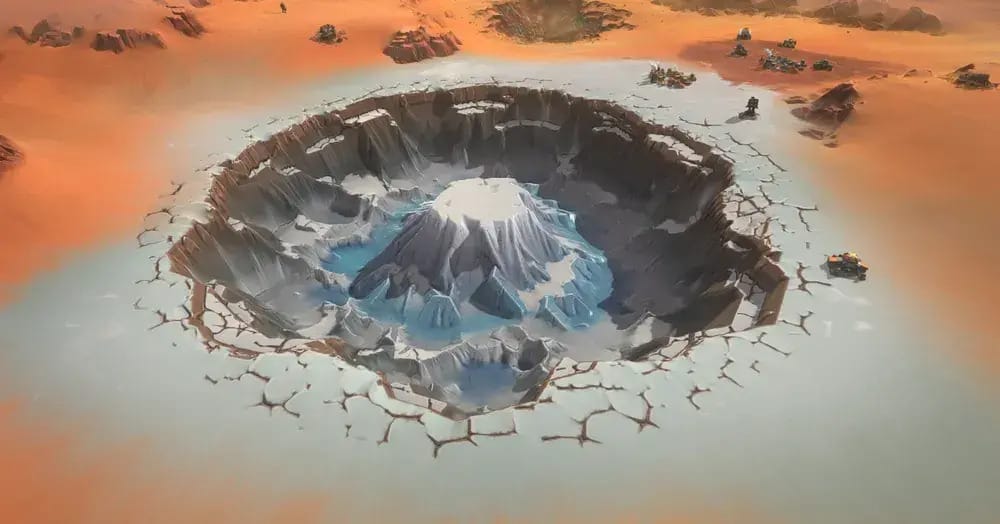
From these we know that the ice sits in a "Polar Sink: 500 m. below Bled level."
Take a moment to imagine that: a massive bowl filled with what little ice Arrakis has to offer.
Wait, here's a picture:
And from the same notes, we also know that you can boldly walk with rhythm here because, despite a lack of open water, the humidity alone is too much for Shai-Hulud.
Wormline: indicating farthest north points where worms have been recorded. (Moisture, not cold, is determining factor.)
— Cartographic notes, Dune [1965]
So, coming back to my original question: if there's a polar cap (even if it's tiny), then why isn't there any water around the ice?
On Earth, our polar ice doesn't just abruptly stop - moving from north to south, we have tundra, taiga, temperate forests, and so on.
But Arrakis is different in at least three major ways.
The main difference, of course, is the sandworm.
Canonically, we know from Leto II (specifically from his ancestral memories) that the sandworm is not native to Arrakis. The planet now known as Dune was once similar to Earth, but then…
"The sandtrout," he repeated, "was introduced here from some other place. This was a wet planet then. They proliferated beyond the capability of existing ecosystems to deal with them. Sandtrout encysted the available free water, made this a desert planet . . . and they did it to survive. In a planet sufficiently dry, they could move to their sandworm phase."
— Children of Dune [1976]
The "haploid phase of the planet's giant sandworm" is indeed so prolific, pervasive, and thirsty that Fremen "had always known to plant predator fish in their water cisterns" to prevent the sandtrout from drinking all their water.
To put it bluntly, while large amounts of water can be deadly for sandworms, sandtrout suck up any water they can find.
Here's Jessica and Yueh being puzzled by the effects of these creatures:
"But the mystery, Wellington, the real mystery is the wells that've been drilled up here in the sinks and basins. Have you read about those?"
"First a trickle, then nothing," he said.
"But, Wellington, that's the mystery. The water was there. It dries up. And never again is there water. Yet another hole nearby produces the same result: a trickle that stops. Has no one ever been curious about this?"
— Dune [1965]
Sandtrout will drink all the water - but it seems they can't chew on ice.
We've already talked about it, so I won't spend too much time on this.
Just enough to point out that the 0.31-mile deep sink sets the ice apart from the rest of the planet, creating a microclimate that exists in relative isolation from the desert.
The 500-meter depression acts as a natural boundary, preventing gradual transitions between ecological zones.
The final piece of the "polar puzzle" comes from Arrakis's orbital mechanics. Now, this is not core canon but explained in the Herbert-approved fan fiction that is the Dune Encyclopedia.
The planet had little in the way of seasons since its orbit about Canopus was nearly circular and the planet's axis of rotation was directed almost perpendicular to its ecliptic plane. Because of this the small polar ice caps appeared to remain unchanged (orbital observation).
— Dune Encyclopedia [1984]
This orbital configuration is dramatically different from Earth's. Our planet has a tilted axis (about 23.5 degrees) and an elliptical orbit, creating pronounced seasons as different hemispheres receive varying amounts of sunlight throughout the year.
OK, so if the ice turns to water, the sandtrout would go after it - but why not mine the ice and use it to "transform the face of Arrakis?"
Don't take it from me - here's the former Imperial Planetologist who really wanted to make Dune a green paradise.
[Pardot] Kynes thought of installing reduction plants to recover water from the hydrogen and oxygen locked in native rock, but the energy-cost factor was far too high. The polar caps (disregarding the false sense of water security they gave the pyons) held far too small an amount for his project... and he already suspected where the water had to be.
— Appendix I: The Ecology of Dune, Dune [1965]
And while it might not be enough on its own, the Fremen certainly count on using the ice when the time comes.
"It has been calculated with precision," Stilgar whispered. "We know to within a million decaliters how much we need. When we have it, we shall change the face of Arrakis."
A hushed whisper of response lifted from the troop: "Bi-lal kaifa."
"We will trap the dunes beneath grass plantings," Stilgar said, his voice growing stronger. "We will tie the water into the soil with trees and undergrowth."
"Bi-lal kaifa," intoned the troop.
"Each year the polar ice retreats," Stilgar said.
"Bi-lal kaifa," they chanted.
"We shall make a homeworld of Arrakis—with melting lenses at the poles, with lakes in the temperate zones, and only the deep desert for the maker and his spice."
"Bi-lal kaifa."
— Dune [1965]
For now, however, the only use of the ice is to provide a bit of fancy drinking water.
The amount of ice in the polar caps was insignificant, mined by water merchants and hauled down to the cities, where it was sold at a premium.
— Dune: House Atreides [1999]
And speaking of. I'm sure you remember the banquet scene, where the Lady Jessica tries to do some serious networking, inviting the local nobility and bourgeoisie.
Among them, a "watershipper whose summer mansion was near his polar-cap factory" in the north.
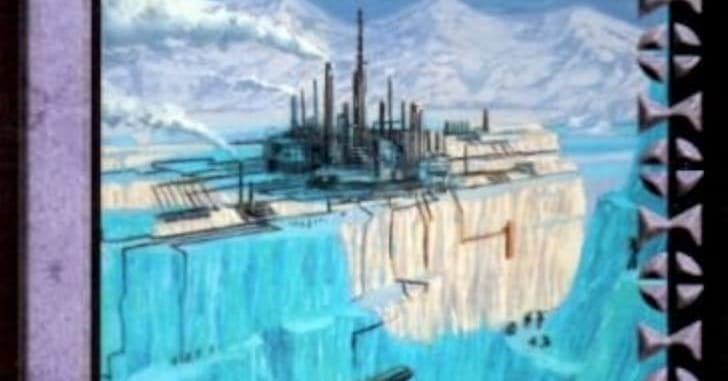
Can you imagine the luxury? It's the Arrakeen equivalent of having a beach house, except your beach is made of ice. A mansion close to one of the coldest places on a blazing hot desert planet.
And while everyone obsesses over recycling their bodies' moisture, you're having freshly picked ice in your spice cocktails as you admire the setting sun from your balcony.
While the northern pole openly hosts water extraction operations, the southern pole is a mystery to everyone but the Fremen.
Throughout the book, we get told the official story of how it's uninhabitable - but then at the very end, we get a glimpse of what's really going on.
"Tell me, my dear Baron, have you investigated the southern polar regions of Arrakis?"
The Baron stared up at the Emperor, shocked by the change of subject. "But … well, you know, Your Majesty, the entire region is uninhabitable, open to wind and worm. There's not even any spice in those latitudes."
"You've had no reports from spice lighters that patches of greenery appear there?"
"There've always been such reports. Some were investigated—long ago. A few plants were seen. Many 'thopters were lost. Much too costly, Your Majesty. It's a place where men cannot survive for long."
[...]
"I, too, sometimes err on the side of caution," the Emperor said. "It has been reported to me that your uninhabited south polar regions exhibit evidence of human activity."
"But that's impossible!" the Baron protested. "The worms … there's sand clear to the …."
"These people seem able to avoid the worms," the Emperor said.
— Dune [1965]
And again, if you're a completionist and keep reading, you get definitive confirmation:
Palmaries of the South: do not appear on this map. They lie at about 40° south latitude.
— Cartographic Notes, Dune [1965]
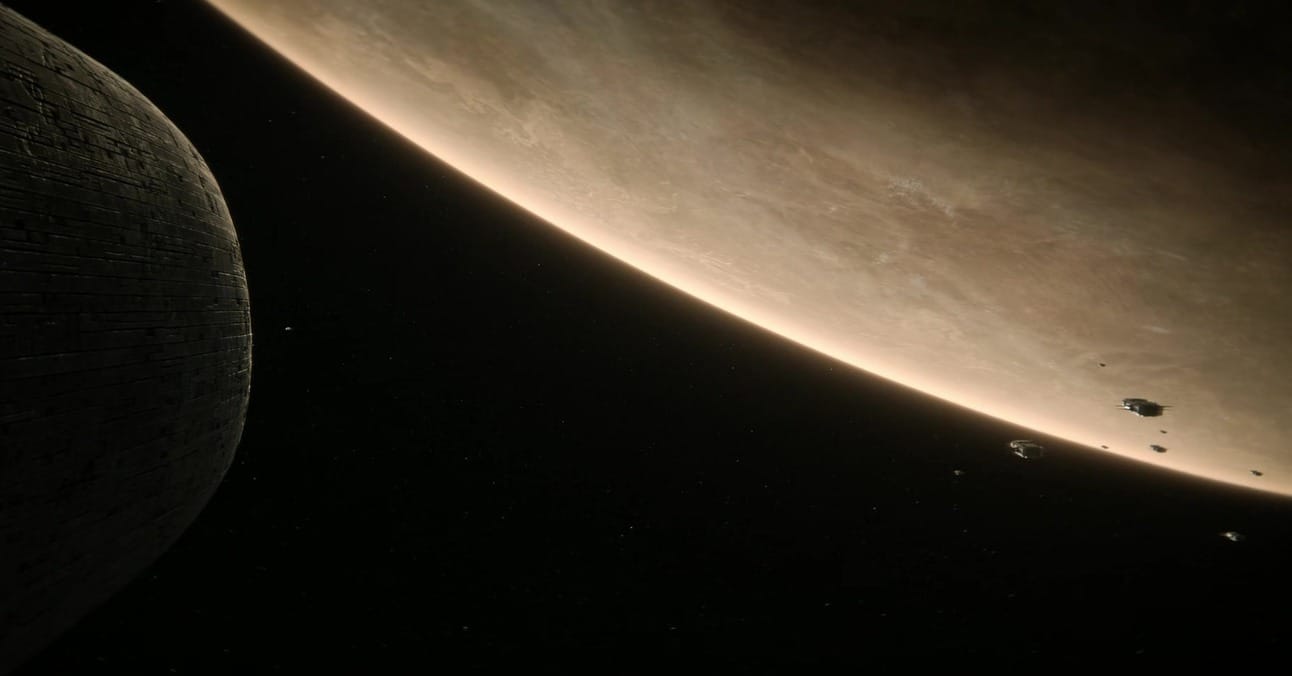
If you want to explore the southern hemisphere, there's a whole subplot about these palmaries in the Prelude to Dune trilogy.
Kynes was speechless. It was his dream, before his very eyes!
[…]
"Behold our secret, Umma Kynes," Stilgar said. "We have done all this in less than a year."
Tufts of hardy grass grew in moist patches on the floor of the arroyo, bright desert sunflowers, even the low, creeping vines of a tough gourd plant. But most amazing of all, Kynes saw rows of stunted young date palms, clinging to life, sucking up the moisture that found its way through cracks in the porous rock and seeped up from a water table beneath the canyon floor.
"Palm trees!" he said. "You've already begun."
"Yes, Umma." Stilgar nodded. "We can see a glimpse of Dune's future here. As you promised us, it can be done. Fremen from all across the world have already begun your tasks of scattering grasses on the downwind sides of the dunes to anchor them."
— Dune: House Atreides [1999]

.svg.png)
.png)

If you wanna chat, find me on BlueSky.
Even if you're not a supporter (yet), you can get new articles as an email as soon as they're published - full length for free stuff and a preview of the premium content.