Stop me if this has happened to you before.
Someone you loved - like an older brother type figure - dies saving your life. And then a decade or so later, a spice-breathing fishman shows up at your royal court and presents you with the reanimated corpse that has no memory of you. Oh, and just for giggles, the people who brought him back to life upgraded him not only in the mentat but also the zensunni philosopher skill tree.
If you can relate, you might be Paul Muad’Dib in Dune: Messiah. Or his ghola.
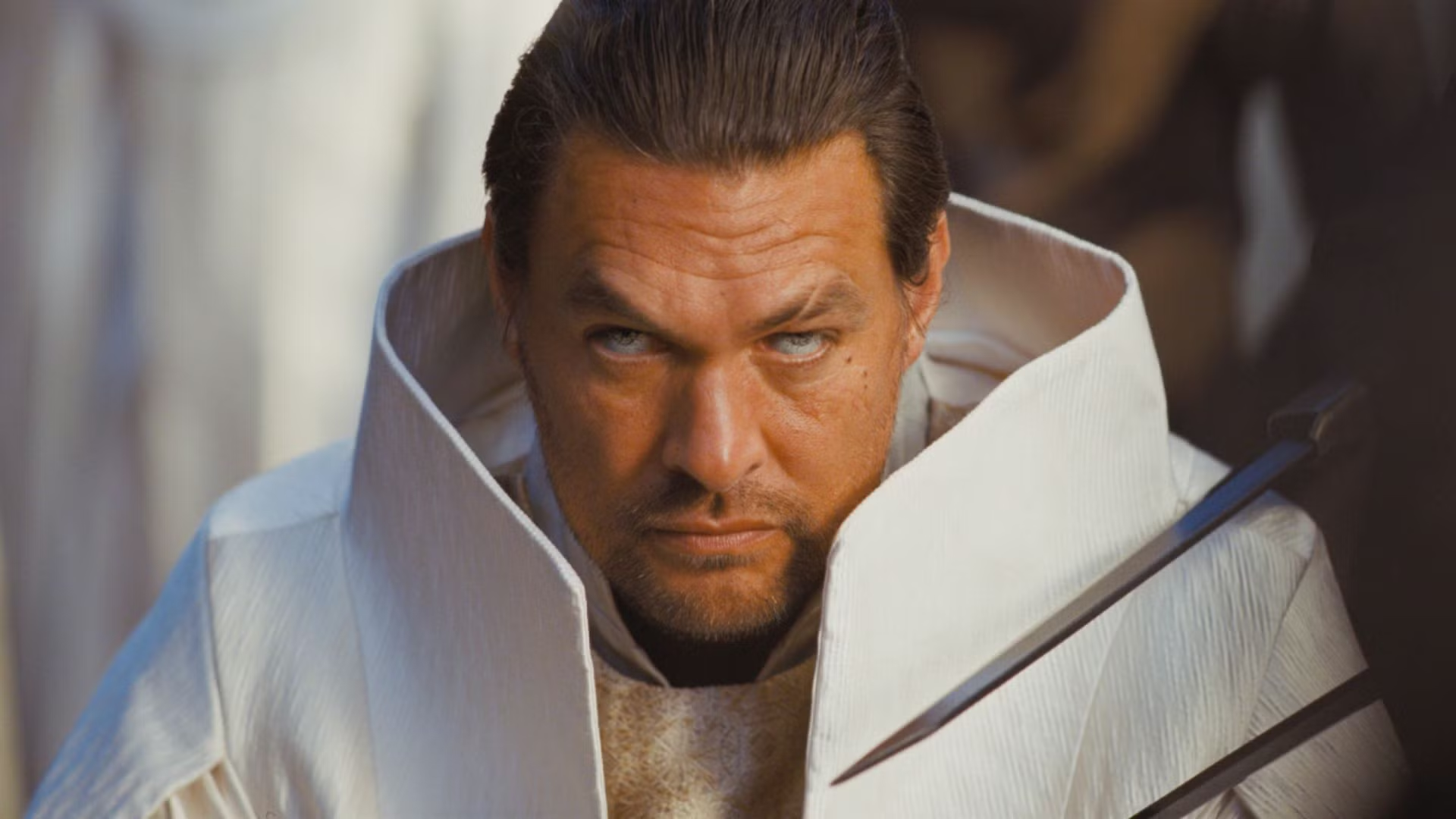
While in-universe they’re not considered new tech, the first ghola we ever meet is Duncan Idaho, revived and renamed - now going by Hayt -, with high-tech metal eyes but without any memory of his former life.
With Dune: Part Three, I expect a lot of people are gonna try to figure out what exactly a ghola is, how they’re made and how they work, so this is my attempt at a canonically correct collection of answers.
Hold on to your maker hooks because this is gonna get weird.
While I usually reach for the Terminology of the Imperium in the back of the original Dune, gholas were not a thing in the first book, so its glossary doesn’t include them.
Thankfully, in Heretics we get to visit a Bene Gesserit library, which provides the following definition: “Gholas: humans grown from a cadaver's cells in Tleilaxu axlotl tanks.”
The bit to underline there is “cadaver” - because Dune also has clones, and while the later books manage to blur the lines in terms of practicalities, the difference between the two is (or at least it was supposed to be) that clones are copies of people, while gholas are the original flesh restored to life.
But only the flesh.
"I know nothing of my past for sure, my Lord. It was explained that I can have no memory of my former life. All that remains from before is the pattern set by the genes. There are, however, niches into which once familiar things may fit. There are voices, places, foods, faces, sounds, actions -- a sword in my hand, the controls of a 'thopter . . . "
— Hayt introducing himself to Paul Muad’Dib, Dune: Messiah [1969]
And interestingly, although it’s the original body that's revived, the Tleilaxu can add upgrades and modifications to the genetic material as well, not just provide additional training. The best example is yet another Duncan Idaho ghola, a few thousand years after the first one, who needed his nerve-muscle system modernized so he could keep up with the much faster humans of that time.
The end of Dune: Messiah provides a grim but simple summary of the process.
Most importantly, you need to preserve the corpse - and fast. Ideally, you flash-freeze it. Lacking any sense of tact, both Scytale and Bijaz are urging Paul to get a “cryological tank” so they can “preserve the flesh” of his beloved.
You then ship the body to the Bene Tleilax, who’ll regrow whatever got damaged on the way out and spark it back to life.
Edric rolled in the tank, bringing his attention to bear on the ghola. "This is a man called Hayt," he said, spelling the name. "According to our investigators, he has a most curious history. He was killed here on Arrakis . . . a grievous head-wound which required many months of regrowth. The body was sold to the Bene Tleilax as that of a master swordsman, an adept of the Ginaz School. It came to our attention that this must be Duncan Idaho, the trusted retainer of your household. We bought him as a gift befitting an Emperor."
— Dune: Messiah [1969]
But there is a limit to what the Tleilaxu can do, as later in the book we encounter a young Fremen woman’s corpse in the desert whose “flesh is too far gone to be regrown.”
Fast forward three and a half thousand years, and this isn’t a problem anymore. By the time of the God Emperor the Tleilaxu have figured out a way to “decant” new Duncan gholas from “a bud” - Idaho’s own description of the well-preserved stash of cells in deep storage. And what that means is that they can grow full adults without needing the original brain.
This certainly sounds more like cloning and less like biotechnological necromancy, but throughout Heretics and Chapterhouse we’re reminded that the main difference is that one technique copies a living being while the other revives / regrows a dead person.
Either way, by this time the tech is so advanced that a few cells is all we need for a full resurrection - and the Tleilaxu masters are carrying around whole villages.
Scytale rubbed his breast, reminding himself of what was hidden there with such skill that not even a scar marked the place. Each Master had carried this resource -- a nullentropy capsule preserving the seed cells of a multitude: fellow Masters of the central kehl, Face Dancers, technical specialists […] Paul Atreides and his beloved Chani were there. […] The original Duncan Idaho was there with other Atreides minions -- the Mentat Thufir Hawat, Gurney Halleck, the Fremen Naib Stilgar…
— Chapterhouse: Dune [1985]
But what do you do with those cells, you ask?
Well, you use an axlotl tank to grow them. If you don’t know what they are, here’s an extra spoiler warning: skip over this paragraph. Because in one of the biggest plot twists of Heretics it turns out that the reason no one ever saw a female of the Bene Tleilax is that all of the women have been turned into giant gestation pods that produce everything from individual organs to full-grown gholas, Face Dancers and (in the end) synthetic spice. This of course is somewhat of a retcon, as in Messiah both Hayt and Bijaz talk about seeing the tanks, and neither of them seemed to have been weirded the hell out. Be it as it may, by the time we get to Chapterhouse, the Sisterhood has given up on all their principles and has their own axlotl tanks, created with volunteers. This from the organization that was appalled to use IVF for their breeding program just a few thousand years earlier, even if it meant getting Paul Muad’Dib’s genes.
As explained by Hayt, despite not having his original memories, he retained his abilities as both a swordmaster and a pilot.
And that’s the entire commercial logic of the ghola business. The Bene Tleilax are essentially running a recycle / upcycle service for grave robbers and killers.
Edric lays it out for us when he explains their plans to Irulan.
"Even in defeat," Edric said, "your father's Sardaukar did not abandon wisdom. Let us suppose a wise Sardaukar commander recognized the swordmaster in a corpse his men had slain. What then? There exist uses for such flesh and training . . . if one acts swiftly."
— Dune: Messiah [1969]
With the Tleilaxu being able to give him a second lease on life, Duncan became a useful asset to the Sardaukar, who thought they could turn him into an instructor - or anything else they might need.
The moral hand-wave that justifies the whole operation is a weird one: since the ghola doesn't carry the original's memories, no real harm is done to the person.
And a ghola is certainly not considered a person - it’s property. And an extremely rare piece of property, too.
Paul, on first seeing Hayt commented that he always thought “Gholas were ghosts to frighten children.” and that “He'd never thought to know one.”
So Hayt is indeed "a gift befitting an Emperor" - not just because of who he used to be, but because of how rare a thing he is now.
And while you might be correct in saying this is still slavery, throughout Messiah the characters interacting with Hayt constantly prove to us that gholas are at least looked down upon, but usually treated with heavy disdain. And this persists into the later books, with even Bene Gesserit reverend mothers getting the heebie-jeebies.
The distrust can be partially attributed to the source: people don’t trust the Bene Tleilax and “what did they do to this one” becomes a perennial question. For good reason: we learn from Scytale that similar to some tech companies, the Tleilaxu include a “backdoor” in every ghola - a “whistling language” is impressed on them so their true creators can retain ultimate control.
Either way, gholas exists somewhere below the threshold of full personhood.
Even when the original person is truly brought back.
Before Hayt, no ghola has regained their original memories and personality.
And it wasn’t for a lack of trying either. Heck, the Tleilaxu were able to grow their own, genuine article Kwisatz Haderach (not Paul, a different one), so they know what they’re doing. And yet, the trick of true restoration evaded them.
But with Hayt they had a plan. In fact, a plan within a plan within a plan.
Their theory was that if they could create a conflict of conscience between what the regrown body was commanded to do and what the original personality would do, that the resulting psychic friction might tear down whatever inner wall that was separating the ghola from their pre-death self.
And so they programmed Hayt to kill Paul, in the hopes that Duncan Idaho would intervene. And he did.
A sensation of living two lives simultaneously spread out through his awareness: Hayt/Idaho/Hayt/Idaho . . . He became a motionless chain of relative existence, singular, alone. Old memories flooded his mind. He marked them, adjusted them to new understandings, made a beginning at the integration of a new awareness.
[…]
It was done then. He knew himself as Duncan Idaho, remembering everything of Hayt as though it had been stored secretly in him and ignited by a flaming catalyst. The corona dissolved. He shed the Tleilaxu compulsions.
— Dune: Messiah [1969]
For this to happen, Hayt had to have not only Duncan’s love and loyalty for Paul, but also the aforementioned mentat and zensunni training, so his mind could survive the shock of coming back from death.
But if you can do it once, you can do it again, and what was undoubtedly a singular miracle of biotechnological necromancy, the Tleilaxu managed to refine into a standardized and repeatable process. Leto II called it "the morality play by which the Tleilaxu reawakened a ghola's pre-death memories." A Face Dancer pretends to be someone the original person loved, the ghola is conditioned to kill the mimic, conditioning collides with cellular loyalty, memories come back online.
By the time we get to Heretics and the Sisterhood-owned ghola program, even the Bene Gesserit have - I kid you not - a manual "On Awakening a Ghola's Original Memories."
Immortality has become almost mundane.
Take Clairby as an example. He’s a minor character in Chapterhouse, one of the Sisterhood’s drivers, and after they turned him into a cyborg to save him, he fully expects to return as a ghola when he dies in the line of duty.
"They didn't tell you?" he asked. "Waste no pity. I was dead and this gave me life. It's Clairby, Mother Superior. And when I die this time, that will buy me life as a ghola."
— Chapterhouse: Dune [1985]
But Clairby is thinking small - only about one death.
The Masters of the Bene Tleilax realized quickly that they could become “serial” gholas, bringing themselves back from the dead over and over and continuing to rule, barely interrupted by death.
Every one of them here had been wakened time after time in ghola flesh. There was a fleshly continuity in this Council that no other people had ever achieved. Mirlat himself had seen the Prophet with his own eyes. Scytale had spoken to Muad'dib! Learning how the flesh could be renewed and the memories restored, they had condensed this power into a single government whose potency was confined lest it be demanded everywhere.
— Heretics of Dune [1984]
They were functionally immortal, right up until the Honored Matres made them functionally extinct.
Here’s a quick who's-who of the named gholas across the core canon.
Hayt
The first ghola we meet and the first ever to recover his original memories. Grown from Duncan Idaho's corpse and gifted to Paul as a mentat-philosopher. Becomes Duncan again, marries Alia, and eventually dies a second time for the Atreides.
Duncan Idaho(s)
Leto II loves himself a good Duncan Idaho, so he keeps buying new ones when the old ones… expire. After Leto’s 3500 years’ worth of gholas, the Bene Gesserit take over the contract and run a dozen more across Heretics and Chapterhouse, ending with one who remembers all his predecessors at once. There's enough material here for a separate piece, so watch this space.
Bijaz
The dwarf who plays Hayt like a fiddle, activating his kill-compulsion. While he’s never referred to as a ghola, he specifically tells Hayt at one point that they’re “like brothers. We grew in the same tank: I first and then you.”
Scytale
Introduced as a Face Dancer in Messiah, he manages to climb the Bene Tleilax corporate ladder despite being killed by Paul, and becomes one of the Masters by the time of Heretics. And we know it’s the same person, because he carries memories all the way back to Muad'Dib's time.
The Tleilaxu Masters
As mentioned before, the entire ruling council - Waff, Mirlat, and the rest - are serial gholas, regrown and memory-restored over and over across thousands of years.
Miles Teg
The first ghola grown by the Sisterhood. The Bene Gesserit grew him from cells Odrade scraped off the original’s fingernails before his death, raised him as a child, and awakened him through Sheeana's imprinting. Technically a clone and not a ghola, which is something discussed a good few times.
Hwi Noree
You could certainly make the argument that she’s not really ghola. But she was grown - the Ixians made her from the cells of Leto's frenemy Malky, using Tleilaxu-derived tech, inside a chamber hidden from Leto's prescience. Moneo calls it "not exactly a ghola, and not even a clone… a cellular restructuring." She's bio-engineered to be Leto's perfect match - and she is.

.svg.png)
.png)

If you wanna chat, find me on BlueSky.
Even if you're not a supporter (yet), you can get new articles as an email as soon as they're published - full length for free stuff and a preview of the premium content.



_01460.jpg)