I'm sure to be an honorary Bene Gesserit after the type of research I did in the last few weeks - spending way more time than I planned on the imperial lineage.
I knew the original books only mentioned Shaddam and his dad, and I remembered that the Brian Herbert books had maybe a dozen across just as many books. So I thought hey, this is gonna be an easy topic to research, I'll just mix in whatever's in the Dune Encyclopedia.
Guess how many I found there.

The end result would make a conspiracy theorist proud - string connections and color-coded annotations, spanning close to 400 named characters and 13,500 years of galactic history.
So grab your spice coffee and settle in. This is going to be a wild ride through the most convoluted family tree in science fiction.
But before we dive into the imperial politics, we need to talk about Dune's canons.
Well before the MCU introduced the world to the multiverse, Dune fans had to contend with multiple timelines and parallel universes. There's no single continuity - we have the core canon, the Dune Encyclopedia and the Expanded Universe.
And while they'll agree on sandworms, spice coffee and muad'dib (the mouse, not the person), there's plenty of discrepancies and even contradictions.
Among these: the history of House Corrino.
In the Core Canon - the six original novels by Frank Herbert - Shaddam IV is identified as 81st of his line. Then we get his dad, Elrood IX (logically, the 80th), Paul Muad'Dib, and Leto II, and that's it. Four emperors, with the last one hogging 3,500 years of the timeline. And the only thing we can deduce is that there were another 3x Shaddams and 8x Elroods - and so they and the other 68 emperors somehow ruled for 10 millennia (?)
Then there's the Dune Encyclopedia - the massive, Frank Herbert-approved fan fiction that ends with Leto II and starts 88 years before the Guild. I completely forgot that it actually provides the complete timeline, numbering each emperor and getting to 374. But here's the fun bit: when I went through the list line by line, trying to construct the family tree you'll find below, I actually found 376 names. The encyclopedists messed up the count. Twice. Yes, really.
Finally, we have the Expanded Universe - the books by Brian Herbert and Kevin J. Anderson. These introduce a completely different timeline with new names and histories, but only give us a handful of emperors from the dawn of the Imperium, along with scattered mentions of others.

All three canons agree on Shaddam, Paul, and Leto - it would be weird if anyone dared to contradict the core canon. But that's the only thing they agree on - even Elrood's reign isn't the same. And when it comes to the ten thousand years before Muad'Dib, things get complicated.
If Shaddam IV is the 81st of his line (as stated in the original Dune), the average reign of each emperor would need to be about 125 years. Spice extends life, but it doesn't provide political stability. Or does that mean there were other lines before the Corrinos? Was there a galactic republic? Who knows what Herbert intended?
The Encyclopedia's history of its 376 rulers provides a much more realistic view, full with political (and physical) backstabbing and feuds for the throne, but to do so, it needs to completely disregards Frank Herbert's established lore:
The Padishah Emperor, 81st of his line (House Corrino) to occupy the Golden Lion Throne, reigned from 10,156 (date his father, Elrood IX, succumbed to chaumurky) until replaced by the 10,196 Regency set up in the name of his eldest daughter, Irulan.
— Dune [1965]
Here, you can count it out yourself:
(I suggest clicking on the image and downloading it so you can zoom in properly.)
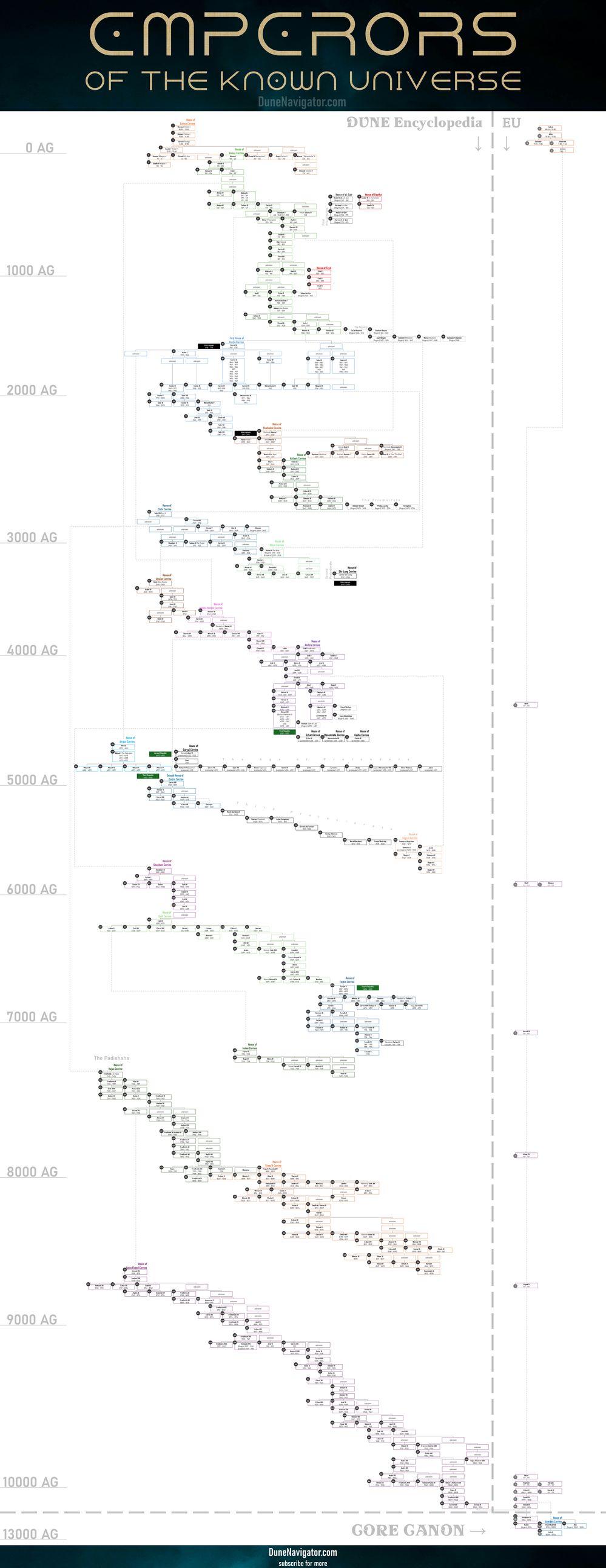
What you're looking at is the family tree of all mentioned emperors across the three canons, with their relationships and reign dates.
I used the Dune Encyclopedia for number crunching, as that's the only source to provide a full account of the imperial line.
Here are the highlights.
Leto II obviously tops this category with 3515 years, but even among non-God Emperors, we have ten who ruled for more than hundred years.
The top 3 are:
Seems like Spice really does extend life when you can afford the good stuff.
The average imperial reign was 36.44 years, though that number is obviously skewed by our sandworm-hybrid outlier. Without him, it's down to 26.17 years per ruler.
There are 26 on the list who didn't even make it to their one-year anniversary on the throne. The most chaotic period was during the Age of Pretenders, and that's where the top of the flops are from:
But if you're looking for a proper Corrino whose rule was extra short, may I present to you his imperial majesty Henli V, who managed to rule for a full 3 days in 3743.
The House of Hajus Elrood Corrino (the one the Encyclopedia says Shaddam IV and Irulan were part of) was the absolute winner both in terms of rulers it produced (58) and the number of years they ruled in total (1505).
Of course, this is not counting Leto II - as we know, he managed to occupy the throne for 3515 years on his own.
Other notable houses are the House of Tiiopa'it Corrino which came in second in terms of number of rulers (38) and the House of Alman Corrino which was second in terms of total years on the throne (1130).
I would've assumed that Sheuset (or its variation in later years, Sheset) would be quite popular, him being the first of the Emperors, but we only got a total of 10 of them.
Compare that to the actual winners:
You really can't be more of a Corrino than having both your first and last name referencing the Battle of Corrin.
Except - of course - if you have a fella who has not one, but two sons going by the name Corrin Corrino - as was the case with Corrin V and his surely adorable kids, Corrin VI and Corrin VII, all three of whom were (obviously) part of the first House of Corrin Corrino, founded by Corrino IV.
No surprise, the easiest way to get on the Golden Lion throne is to make sure your dad was there before you - 152 (so about 40%) of all emperors got there because they were the sons of their predecessors.
Even if you're not the first-born, you have a chance: 65 (or 17%) of emperors were the brothers, and 34 (or 9%) of them were cousins to the person preceding them.
After all of this, it won't come as shock that almost all of these people were men.
According to the Encyclopedia, there were only 18 Empresses (4.5% of rulers), a few of them ruling alongside their husbands or brothers - or in case of Alia IV (3413 - 3441), her brother-husband, Alman VII (3410 - 3449).
Of the 18, 7 ruled because they were daughters, 7 because they were wives, 3 because they were sisters, and 1 because she was the niece of her predecessor.
While I'm sure all 376 rulers had a great life story, my absolute favorite has to be Mikael II The Depraved.
He was the son of Count Atreus Atreides (yes, the same Atreides) who had founded the House of Atreus Corrino through a Sardaukar-backed coup in 4552.
While daddy Atreus had been a reformer trying to merge republican principles with imperial structure, junior took a... different approach.
Mikael II started off seemingly following his father's path, but after nearly dying from chaumurky (poison in his drink), he went full tyrant.
Mikael began to harass the Landsraad, accumulated personal rule, and began a reign of terror unparalleled in Imperial history.
— Dune Encyclopedia [1984]
Things got so brutal that a massive popular revolt eventually forced him off the throne in 4670.
The official story was that he "retired to a monastery" - but in reality, he disappeared before the announcement was even made, his fate remaining a mystery for centuries while the citizens celebrated his downfall and restored the Republic.
Plot twist: he got himself into cryogenic suspension.
In 4813, he was thawed out and somehow managed to retake the throne, ruling until 4888 when his eldest son (whom he'd kept imprisoned most of the poor kid's life) finally deposed him.
Then came the brief reigns of the brother-Emperors - Mikael III through VI - but daddy dearest wasn't finished.
In 4913, Mikael II escaped from his prison cell, gathered a few loyal guards, and had his surviving sons murdered, reportedly saying: "I can always breed new sons."
Cold-blooded doesn't begin to cover it.
His third and final reign lasted only two years. In 4915, while taking a bath, he was murdered by one of his own daughters, who threw a large piece of pure sodium into the water. And just to make sure the nightmare was truly over, his remains were left to rot in the sun outside the doorway to his palace.
If you're keeping score, that's: nearly poisoned, frozen, imprisoned, escaped, murdered his own sons, and finally killed by his daughter in perhaps the most scientifically creative assassination in imperial history.
All told, the guy ruled for a combined 106 years across THREE different centuries.
When you scroll through the imperial timeline, you'll notice a good references that seem to be fan service. It looks like the authors of the Dune Encyclopedia couldn't resist dropping easter eggs and insider references. Some benign, some contradicting the core canon.
In the first thousand years we have House Rautha and House Feyd - both founded by usurpers, bad guys doing bad guy things. An obvious call-back (or call-foward?) to our Harkonnen na-baron Feyd-Rautha.
Then one a half thousand years later, there's the house founded by Halleck I, husband to Alia II, a nod to Gurney Halleck.
And finally, the House of Atreus Corrino, founded by Atreus Atreides, who only took over as emperor to stabilize. in his nobility,
However, there's one name that feels a bit off.
And I'm sure it can be easily explained away as a coincidence, but on the face of it, I have to assume that Ghanim (the husband of Alia III, acting as Regent between 2838 - 2842) was supposed to be the male version of Ghanima.
But "ghanima" is a Fremen word meaning "spoils of war" that wasn't used as a name until Paul Muad'Dib named his daughter thousands of years later.
Whatever fan service was sprinkled in, and however it contradicts the core canon, the reason I love the complete imperial history are the messy details that were added.
Real history isn't a clean, straight line - it's chaotic, contradictory, and often manipulated by whoever's writing it down.
The succession patterns reveal brothers overthrowing brothers, cousins claiming thrones, and occasional usurpers seizing power - exactly the kind of messy family drama that defines real royal histories from the Tudors to the Romanovs.
The imperial timeline isn't just a neat succession of ruler after ruler – it's punctuated by fascinating power vacuums and contested periods. The data reveals several significant interregnums where central authority effectively collapsed.
One notable example is the 14-year gap between Kalus I and Harmon II, where the historical record goes eerily silent on who, if anyone, held imperial power. Another appears during the Age of Pretenders, when multiple claimants created a fractured political landscape that defies clean historical categorization.
These gaps in imperial continuity mirror real historical interregnums like the Time of Troubles in Russia or the period following the collapse of the Han Dynasty.
What's particularly believable is how these periods tend to follow especially weak or disputed successions – just as in real history, when legitimate authority is unclear, the entire system sometimes fragments rather than simply transferring power.
Perhaps the most surprising element in the imperial timeline is the periodic emergence of republican governments. Following Mikael II's overthrow in 4670, a republic was established and lasted until his cryogenic restoration in 4813 – a remarkable 143-year experiment in non-monarchical governance.
Similar republican interludes appear after other particularly disastrous imperial reigns, suggesting cycles of autocracy and republican reform that parallel Earth's own political evolution.
The limited information we have about these republics indicates they were likely oligarchic rather than truly democratic, dominated by Great Houses and commercial interests – again mirroring how many real-world republics functioned before modern democracy took hold.
These republican periods add textured realism to the imperial timeline, acknowledging that even in a feudal galactic society, alternative forms of governance occasionally emerge.

.svg.png)
.png)

If you wanna chat, find me on BlueSky.
Even if you're not a supporter (yet), you can get new articles as an email as soon as they're published - full length for free stuff and a preview of the premium content.