A good few months ago we looked at the working animals of Dune - this time, I thought we could check in on all the animals that you wouldn't find in your local zoo.
(So we'll be skipping any generic mention of hares and eagles and owls, etc.)
Notice I didn't say alien animals, because (at least in the core canon) only one of them actually is: the sandworm.
All the others are either bred, mutated or genetically engineered versions of our Earth fauna: horses, slugs, pigs, etc.
Slugs + Pigs = Sligs
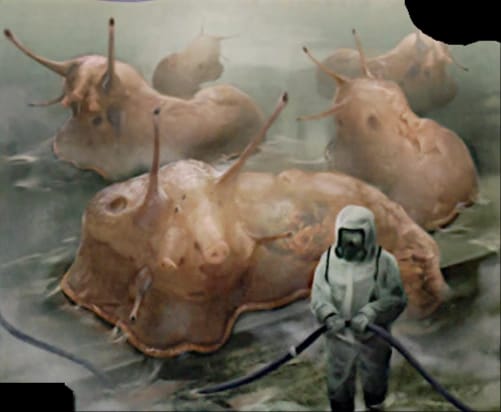
Yes, you heard that right. One of the Tleilaxu masters had the bright idea to cross giant slugs with pigs to make… sligs. Now if that sounds disgusting, hold on to your black aba robes, because it gets better.
They're a two for one deal: while alive, they chomp through all your garbage and waste, and once butchered, they provide the period best period meat period, in the known universe. Period.
Those slowly creeping crosses between giant slugs and pigs might provide meat for some of the most expensive meals in their universe but the creatures themselves embodied everything the Sisterhood held repugnant about the Tleilaxu. Sligs had been one of the earliest Bene Tleilax barter items, a product grown in their tanks and formed with the helical core from which all life took its shapes. That the Bene Tleilax made them added to the aura of obscenity around a creature whose multimouths ground incessantly on almost any garbage, passing that garbage swiftly into excrement that not only smelled of the sty but was slimy.
"The sweetest meat this side of heaven," Bellonda had quoted from a CHOAM promotion.
— Heretics of Dune [1984]
Let me move you away from disgust to the cutest furniture you've ever had to feed.
Chairdogs are super comfortable but require sustenance and expensive staff to maintain, making them luxury items that scream wealth. They come in various colors - blue specimens are particularly rare - and they have eyes and emotions. In Heretics of Dune, one "squeaks with indignation" when disturbed.
And while we never get to see any of their cousins, chairs are not the only form they take.
Teg's dislike of chairdogs and other living furniture was well known.
— Heretics of Dune [1984]
Other living furniture? Even chairs are weird, if you ask me. But I ask you: what furniture would be better if it were living?
One thing to note for the record: while you and I might think of them as a Dune thing, chairdogs first popped up in another Frank Herbert universe, one and a half decades earlier. Specifically, in a book called Whipping Star, a novel from 1970 that I can only recommend.
Undoubtedly the star of the show: Shai Hulud.
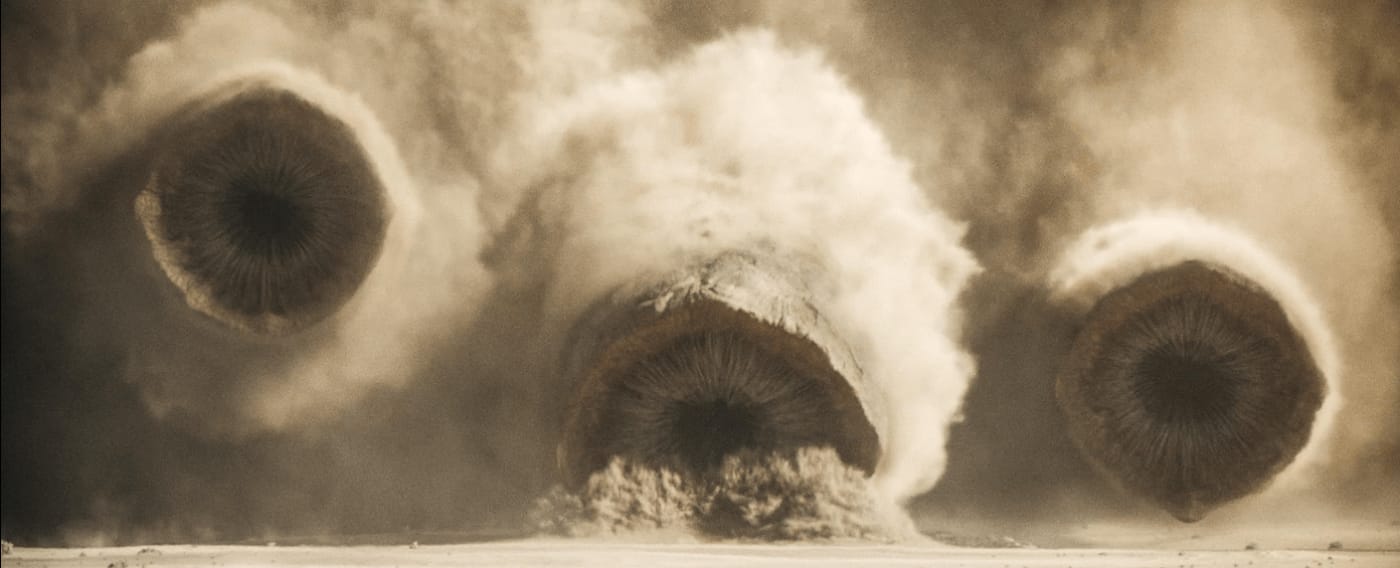
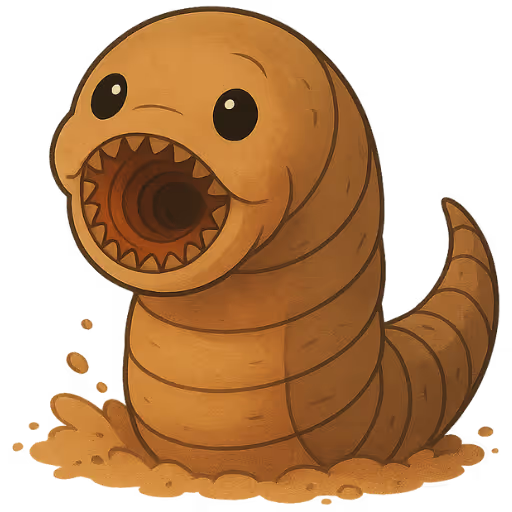
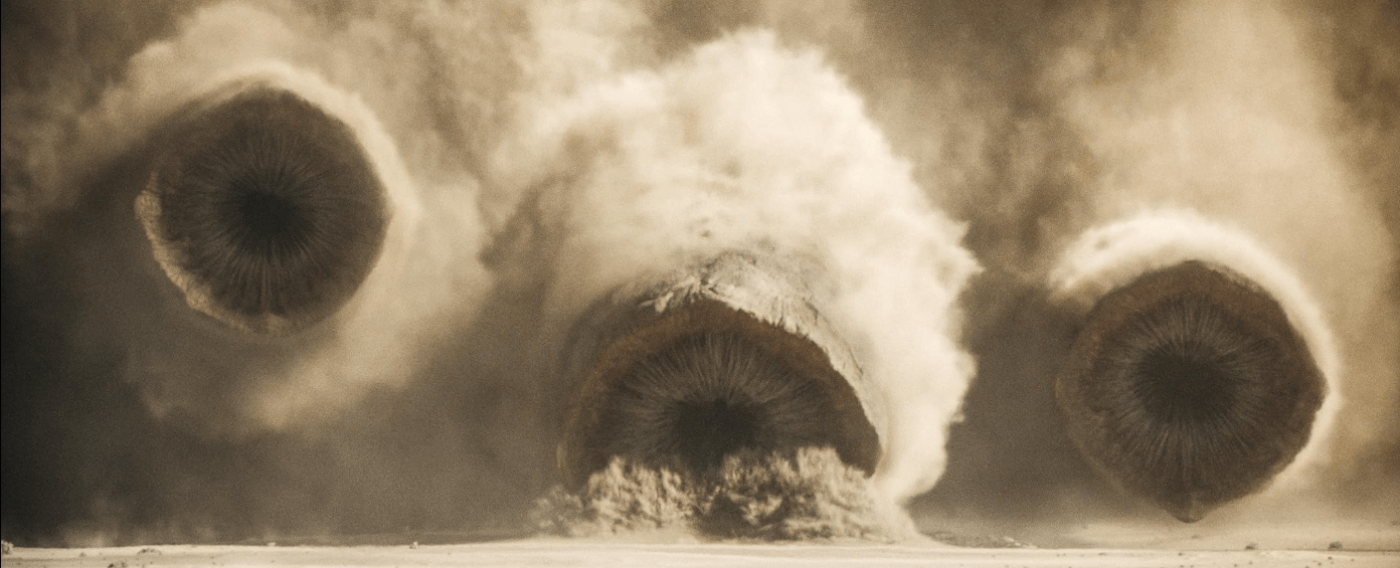
This colossal annelid (thanks thesaurus.com) can reach 400+ meters in length with a mouth spanning 80 meters. That's not just big → that's "swallow a frigate whole" big.
Its lifecycle and relationship to sandtrout and sand plankton deserve a whole separate piece, so for now I'll leave you with a reminder that Arrakis was once a lush paradise.
[Leto] fell silent and [Ghanima] wondered why he kept referring to the haploid phase of the planet's giant sandworm, but she dared not prod him.
"The sandtrout," he repeated, "was introduced here from some other place. This was a wet planet then. They proliferated beyond the capability of existing ecosystems to deal with them. Sandtrout encysted the available free water, made this a desert planet . . . and they did it to survive. In a planet sufficiently dry, they could move to their sandworm phase."
— Children of Dune [1976]
This also proves their utterly alien origin.
The only other potentially alien piece of fauna in the core canon is a schlag.
SCHLAG: animal native to Tupile once hunted almost to extinction for its thin, tough hide.
— Terminology of the Imperium, Dune [1965]
But we won't ever know what kind of animal it is because in the story's text it's just a throwaway reference, used exactly once.
Jessica crossed to the deep, old-fashioned armchair with an embroidered cover of schlag skin, moved the chair into position to command the door.
— Dune [1965]
Let me know what you think a schlag is. I really want to know.
As mentioned before, the core canon provides us with what's essentially Earth animals with millennia of selective breeding and genetic modification.
The primary beasts of burden in the Imperium, with a notable upgrade from your regular horses: two extra legs. The Dune Encyclopedia notes that these six-legged animals could weigh over 2000 kgs.
They were bred into existence somewhere in the 3500-year span between the stories of Paul and Leto II.
[Idaho] could identify narrow roads, market roads with a scattered traffic of vehicles drawn by six-legged animals which he guessed were thorses. Moneo had said that thorses tailored to the needs of such a landscape were the main work beasts not only here but throughout the Empire.
— God Emperor of Dune [1981]
Another animal with a few upgrades compared to the ones we know: enlarged paws for a desert terrain, enhanced claws that could extend some four inches, and tan coats for desert camouflage.
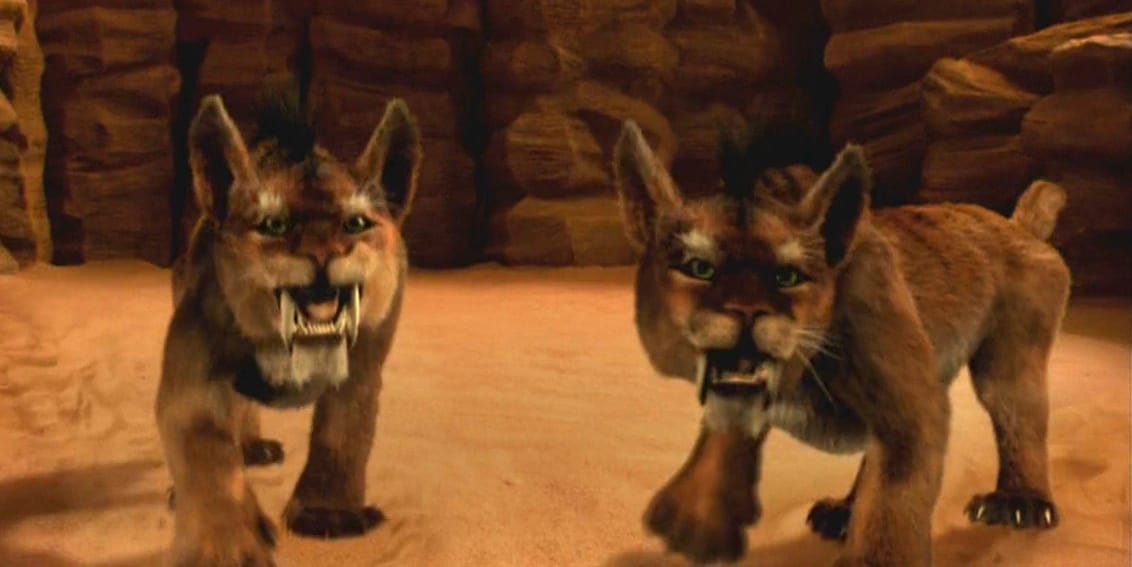
These were created through selective breeding about eight thousand years before Paul's story.
The fangs remained long. Their faces were wide, eyes alert and intelligent. The paws were enlarged to give them support on uneven terrain and their sheathed claws could extend some ten centimeters, sharpened at the ends into razor tips by abrasive compression of the sheath. Their coats were a flat and even tan which made them almost invisible against sand.
They differed in another way from their ancestors: servo-stimulators had been implanted in their brains while they were cubs. The stimulators made them pawns of whoever possessed the transmitter.
— Children of Dune [1976]
The D-wolves are but an extension of my purpose and my purpose is to be the greatest predator ever known.
— The Lost Journals, God Emperor of Dune [1981]
Massive in size, these wolf-dogs bred by Leto II were as tall at the shoulder as a human.
D-wolves were noted for their keen eyesight. There were Gaze Hounds in the ancestry of Leto's forest guardians and he bred the wolves for their eyesight.
[…]
D-wolves were allowed to eat anything they brought down in the Forbidden Forest. Everyone knew this. It was why the wolves roamed the forest the guardians of the Sareer.
— God Emperor of Dune [1981]
The Dune Encyclopedia, like any good encyclopedia, provides us with scientific classifications and evolutionary context for a lot of the animals mentioned just now.
Sandworms for example receive the formal designation Geonemolodium arraknis or Shaihuludata gigantica, with ancestral forms traced back 50 million years to tiny Protochordata worms called Shaihuludata.
But it also mentions a lot of new animals - some descendent from Earth, some native to other planets.
Rya Wolves of Salusa Secundus were "insatiable predators" averaging 1.5 meters at the shoulder, capable of speeds over 95 kmph. They served as ecological regulators, keeping all other lifeforms (including humans) from overpopulating their harsh world. Hunting females could take down full-grown ganja (partially domesticated buffalo).
Gaze Hounds are dogs native to Centralia, known for exceptional visual acuity that made them popular watch animals throughout the Imperium. They were bred with various wolf strains to create the enhanced D-wolves.
The Heart Scallop (Perpetuus opercularis) of the Forannis Triad grows over 300 pounds and begins life as an airborne polyp before anchoring to cliffs or trees. Its continuous bellows action - pumping air through its alimentary canal to strain microorganisms - was adapted as biological engines for ornithopters.
We have throw-away references too, like the Clappets of Sammel which are "small, four-legged furry animals" that excel at "sniffing out spice beds," making them valuable to prospectors. Or the Slandai and Plake of Ecaz that are only mentioned as a comparison to Thorses, noting that they also possess "rudimentary mid-torso organs" that make them the only other known mammalian species with six-limb arrangements.
But if you're looking for truly alien fauna, you'll love the Expanded Universe of Brian Herbert books.
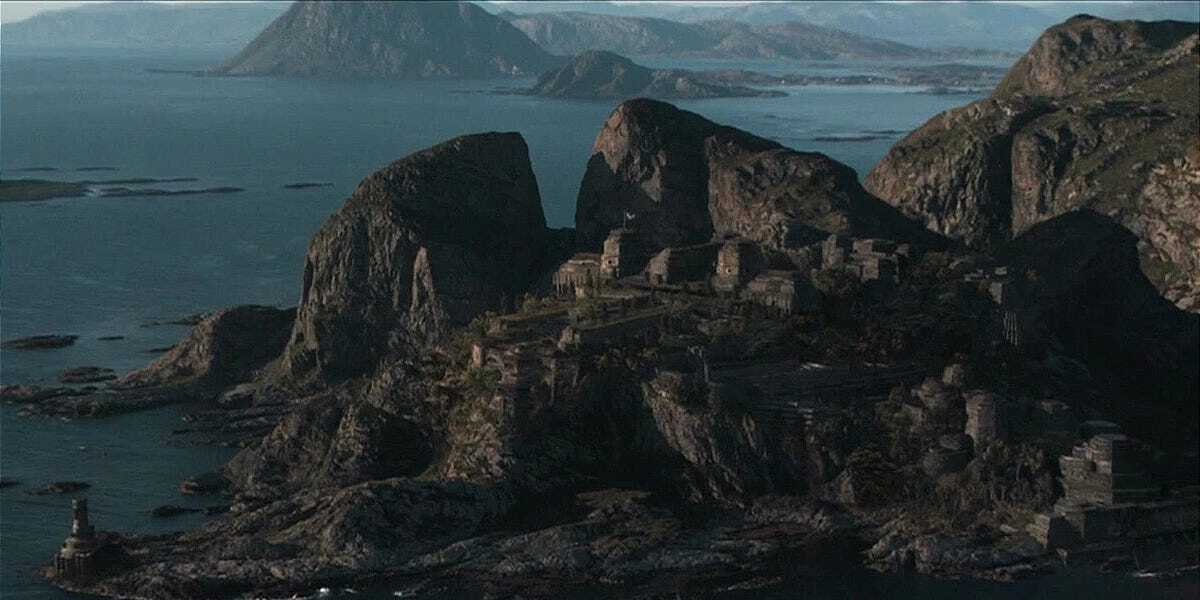
Elecrans are Caladan's kraken, except crossed with high voltage - they're legendary, huge beasts, so rare that most people don't even think they're real. It doesn't help that they can be described as elementals, seeing how they can only maintain a corporal form in water - or dissipate.
Manta birds are another electric breed. These "gray, fleshy, smooth-winged creatures" feed in tide pools but can take flight with "rubbery wings like sails." They exhibit a "crackle of blue electricity" along their wings.
Moving over to Lankiveil, we have the EU's answer to whale fur: the Bjondax whale. These creatures swim "like aquatic bison" in Lankiveil's northern seas, typically golden-furred with rare leopard-spotted variants. They "croon in unison" with songs that resonate "like belches from the cliff walls." Albino specimens are ostracized and rarely survive to adulthood - social behavior that suggests complex herd dynamics.
The Cholisters of Buzzel are "monoped sea creatures" that produce valuable soostone jewels through their "abraded carapace."
Many a Dune fan threw away their book when they first encountered the Seaworms. Why? Because it's a breed of sandworm engineered by the Tleilaxu Master Waff that not only tolerates, but thrives in water. They were released on Buzzell and grew swiftly, producing a more potent version of spice. They appear as a "long, dark shape... breaching like a great whale" in the water. Their emergence destroyed the soostone beds on Buzzell.
Spinehounds are lean, muscular, and wolflike creatures specially bred on Tleilax. They have sharp ears pointed like knives, long and narrow muzzles, and needlelike fur swirled with dark colors, sometimes appearing like burnished metal. Their eyes are a reddish gold. They are dangerous even under the best circumstances, but can be sonically imprinted to obey commands.
Inigo gnats function as miniaturized alien assassins - barely visible, short-lived creatures no larger than the head of a pin that deliver deadly toxic bites before flying away and dying.
My personal favorite has to be the Hermafox. A silver-furred creature, capable of self-replication. It is described as an unusual living bauble that served no useful purpose whatsoever, created by the Bene Tleilax. Cute, self-replicating and serving no purpose? Where have we seen that before…?


.svg.png)
.png)

If you wanna chat, find me on BlueSky.
Even if you're not a supporter (yet), you can get new articles as an email as soon as they're published - full length for free stuff and a preview of the premium content.