
One of the things that made Dune special for me the first time I read it was the epigraphs at the beginning of each chapter.
They felt like a glimpse behind the curtain, provided additional context and world-building, and managed to introduce the Princess Irulan well before we ever got to meet her.

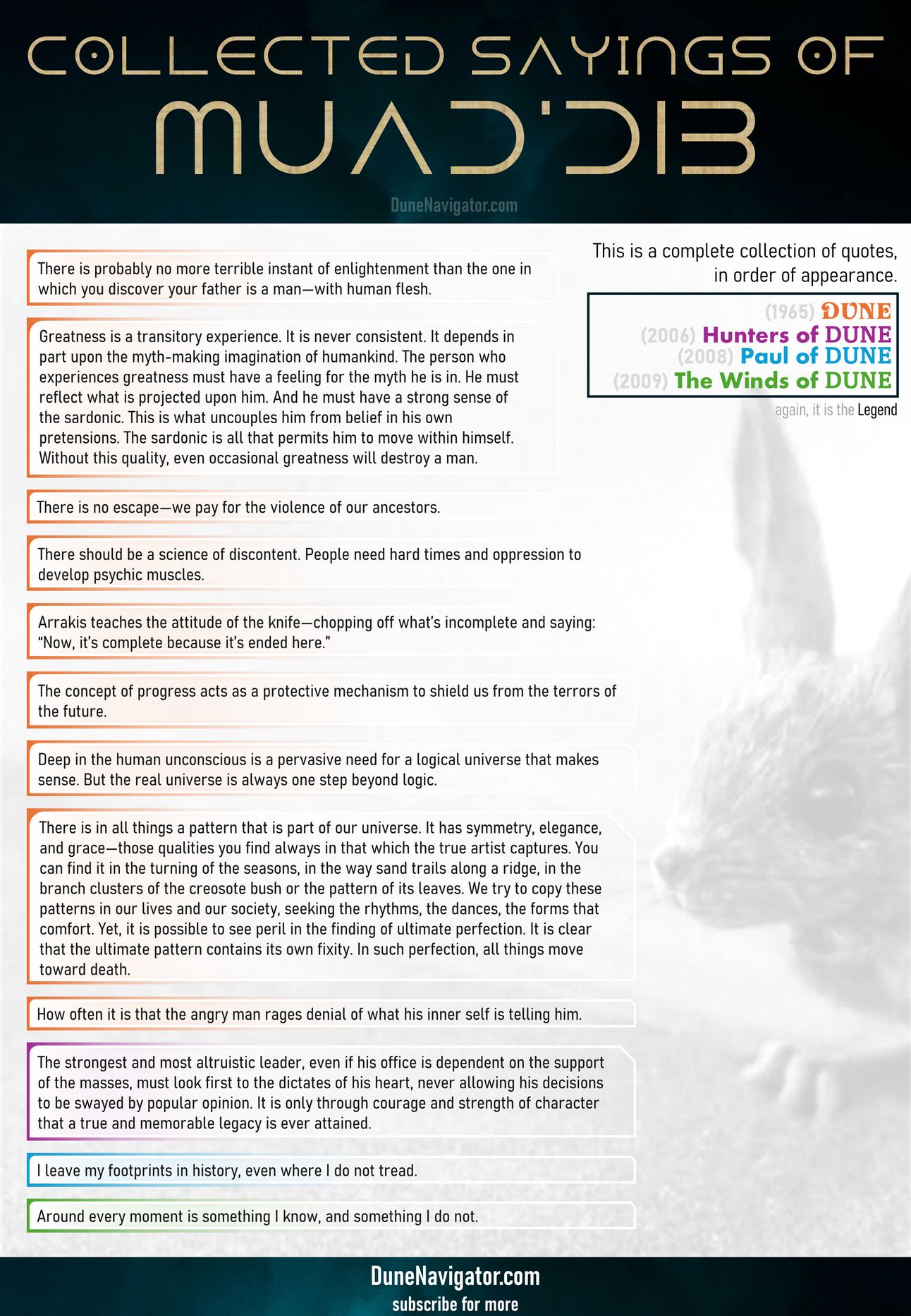
I loved Irulan's epigraph the most, and my favorite of her in-universe books was (of course) the Collected Sayings of Muad'Dib.
Because they're called "sayings" I'm still not sure whether these are things Paul repeated a lot? Were they just "wise pronouncements" he delivered to rapt audiences? Or was it just stuff he muttered while Irulan happened to be within earshot with a notepad handy?
Either way, these quotes form a pattern when viewed as a collection, showing a man grappling with power, prescience, and the uncomfortable weight of his growing legend.
What makes Paul Atreides such a great character is his awareness of his transformation.
Unlike villains who might be viewed as the bad guys but have some relatable reason or just cause, Paul (fore)sees exactly what he's becoming and the consequences of his actions.
The concept of "greatness" in the sayings reveals his uncomfortable relationship with power. His "sardonic" perspective allows him to view his own myth-making with ironic distance. This self-awareness doesn't stop Paul from becoming a tyrant - quite the opposite, he becomes one with open eyes.
Paul maintains this understanding of his persona even as he sets events in motion that will kill billions - 61 billion, by his own count.
Order leads to stagnation. The messiah brings catastrophe. The hero becomes the villain.
These tensions drive Paul's tragedy.
His prescience gives him the illusion of control while actually trapping him in a predetermined path. He sees the consequences of his actions but proceeds anyway, caught in patterns he can observe but not escape.
I love how the philosophical fragments in the Collected Sayings of Muad'Dib consistently undermine simple distinctions.
Logic versus instinct. Progress versus destruction. Violence versus peace.
In each case, the sayings suggest these opposites are part of the same process - that you cannot have one without creating the conditions for the other.
And then of course, the thing I thought to be the coolest when I first read Dune as a teenager: the lessons of the desert.
Survival at any cost, harsh necessity, and sacrifice for the future.
The desert teaches a philosophy of clean breaks and decisive action. It values water discipline, conservation, and planning for scarcity.
Interestingly, these principles serve as the foundation of the Golden Path: hardship and struggle as the necessary catalyst for growth.

.svg.png)
.png)

If you wanna chat, find me on BlueSky.
Even if you're not a supporter (yet), you can get new articles as an email as soon as they're published - full length for free stuff and a preview of the premium content.