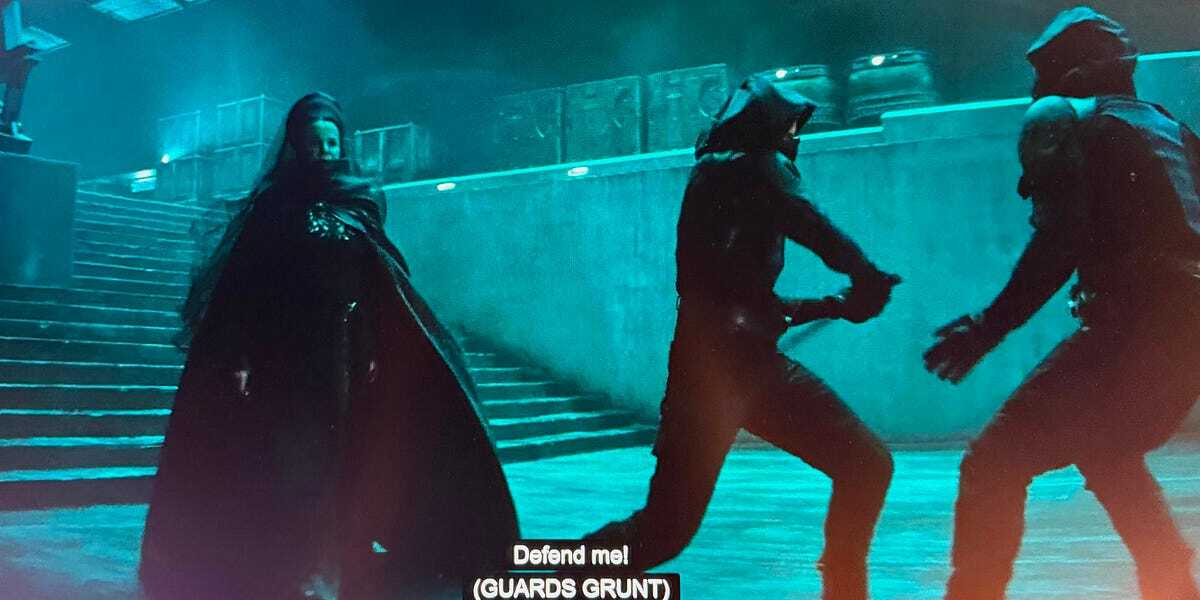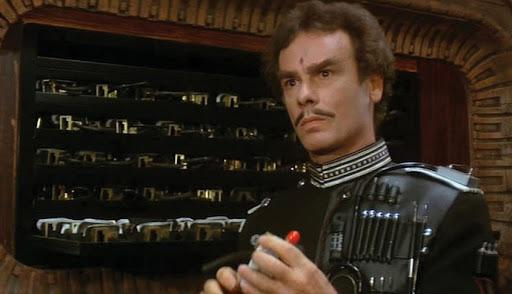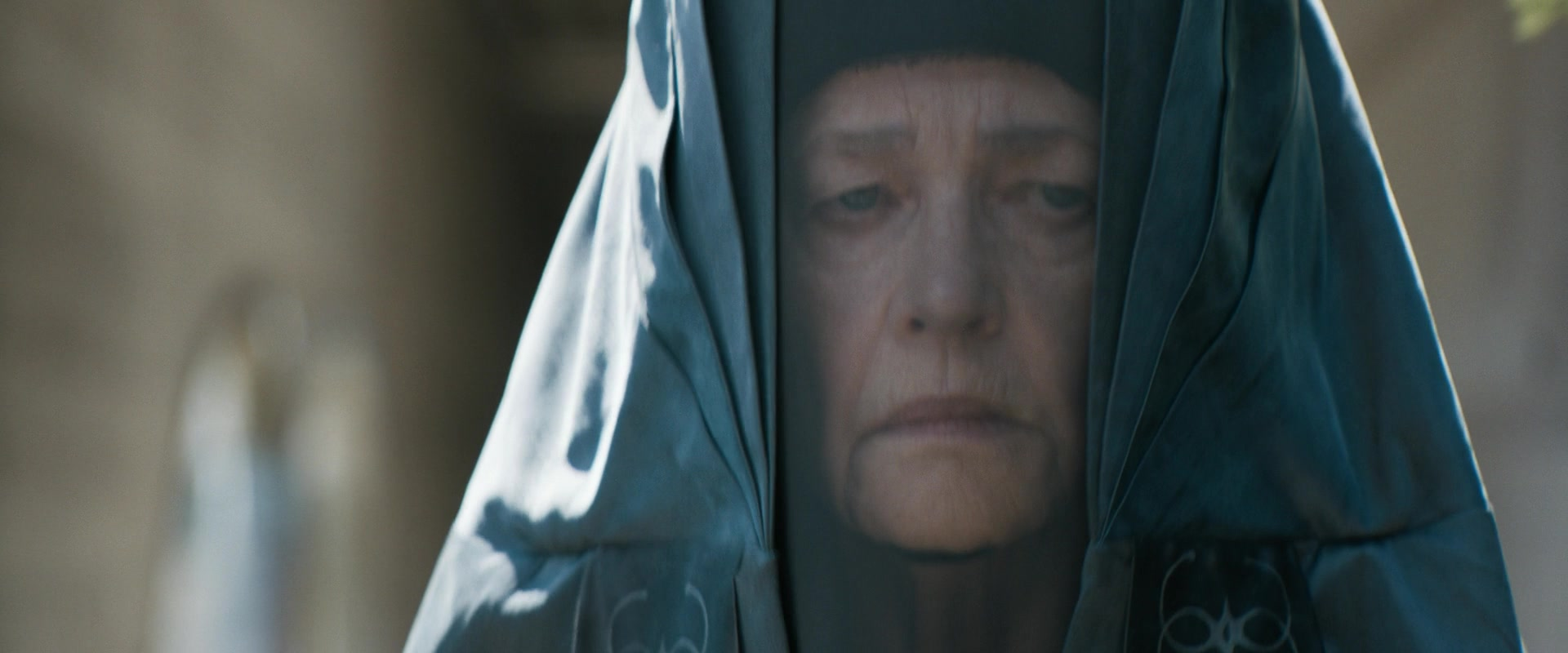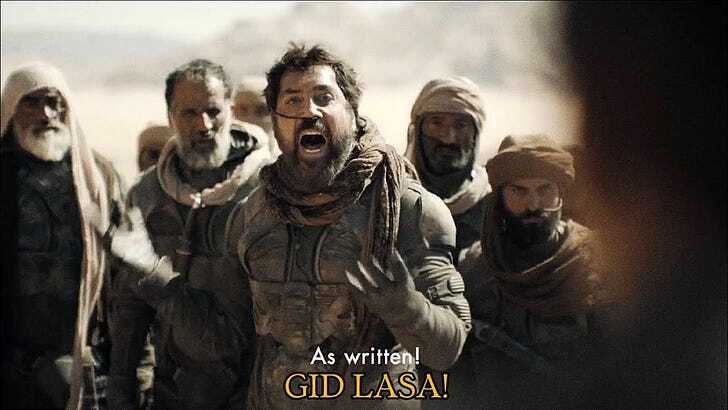
One of the things that really stood out to me during my first read-through of Dune was Herbert's use of language for world-building.
Yes, every sci-fi will need to come up with its own set of made-up words to describe things that do not exist in the real world - whether it's warp cores or glowglobes, there are things that literally need naming -, but what made me a fan is the subtle use of words to communicate cultural backgrounds and allegiances.
"Pity!" the Sardaukar sneered. He advanced, looked down at Leto. "So that's the great Red Duke."
If I had doubts about what this man is, that would end them, Yueh thought. Only the Emperor calls the Atreides the Red Dukes.
— Dune [1965]
You don't need more than someone referring to a sandworm as the Maker to identify them as Fremen - because no off-worlder would even know about the religious significance. (I had a whole rant about it when Dune: Prophecy managed to mess this up.)
Language plays a significant role in my love for Dune, so I thought to do a deep dive in two parts:
While Tolkien made up a family tree of languages for The Lord of the Rings (or made up The Lord of the Rings to house his languages) and Asimov opted to have a single language, Galactic Standard, across the galaxy in his Foundation series, Herbert decided to do something in between.
We have languages for different worlds and cultures (though none of them are well-developed), and we also have a lingua franca.
Unless specified, characters in the novels are generally assumed to be speaking Galach.
GALACH: official language of the Imperium. Hybrid Inglo-Slavic with strong traces of cultural-specialization terms adopted during the long chain of human migrations.
— Terminology of the Imperium, Dune [1965]
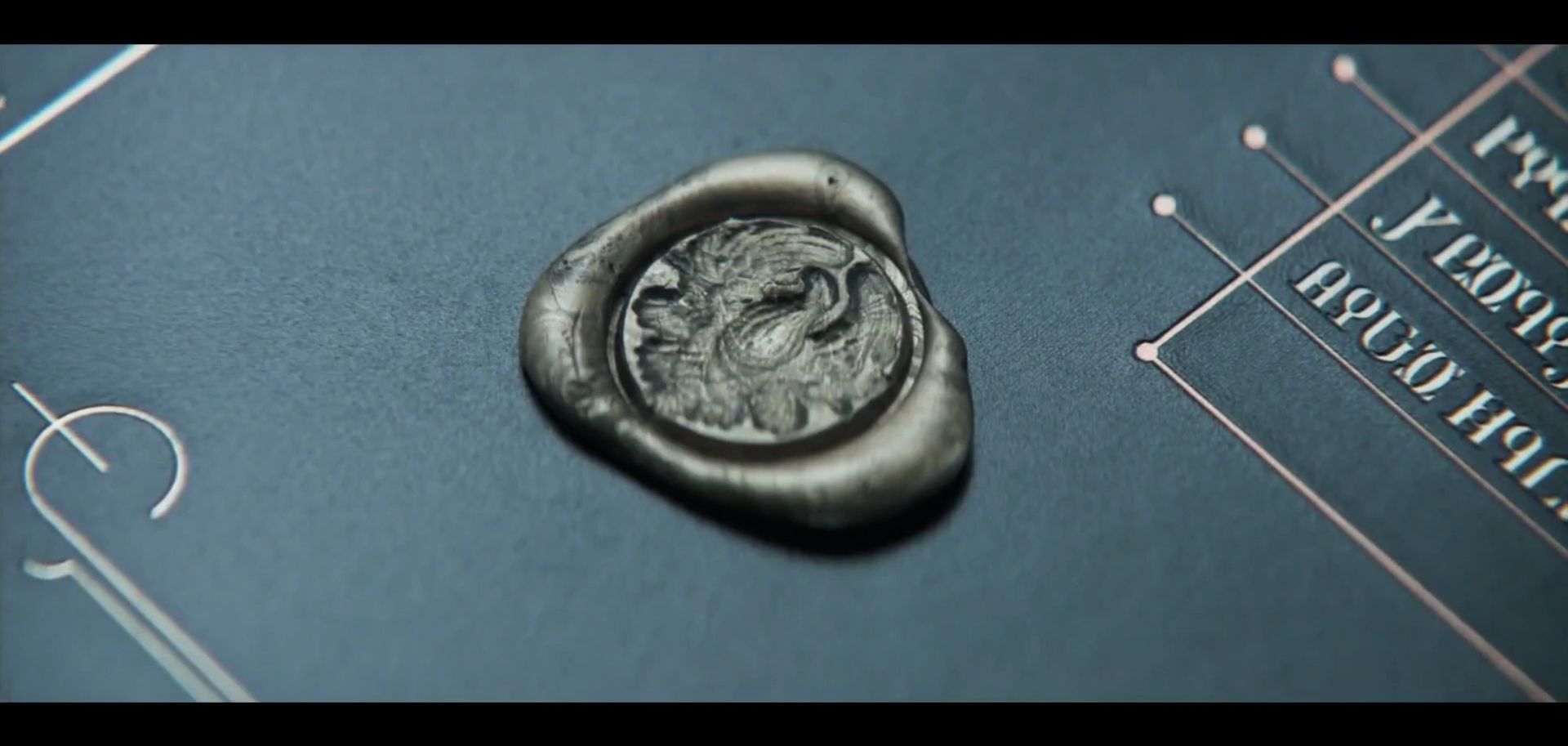
Like so many other things, it's a direct descendant of our Earth.
And since that is the default language everyone uses, and it's already "translated" for us into English (or your language of choice), we don't really get much in terms of what Galach sounds like.
But we do get some tidbits about its vocabulary.
"There are twenty-eight different words for melange in common Galach. They describe it by its intended use, by its dilution, by its age, by whether it came through honest purchase, through theft or conquest, whether it was the dower gift for a male or for a female, and in many other ways is it named."
— Leto II, God Emperor of Dune [1981]
With plenty of loanwords from Earth languages (from Bashar to Landsraad), we also get brand new terms for concepts that didn't need a single word in our time.
CHAUMAS (Aumas in some dialects): poison in solid food as distinguished from poison administered in some other way.
CHAUMURKY (Musky or Murky in some dialects): poison administered in a drink.
RICHECE: Houses Minor, planet-bound entrepreneur class
OUT-FREYN: Galach for "immediately foreign," that is: not of your immediate community, not of the select.
— Terminology of the Imperium, Dune [1965]
Not only does Galach have dialects that differ in pronunciation, but there are patterns of speech that can identify you as a native of a particular planet, if you know what to listen for.
Now, sitting at table with her son and her Duke and their guests, hearing that Guild Bank representative, Jessica felt a chill of realization: the man was a Harkonnen agent. He had the Giedi Prime speech pattern—subtly masked, but exposed to her trained awareness as though he had announced himself.
— Dune [1965]
And as with any language, Galach isn't static. It evolves, even if at a glacial pace - here's Duncan Idaho 5 millennia after his childhood, still understanding and talking to people.
There obviously had been many linguistic drifts since the Dune days of Muad'dib. For that matter, Duncan recognized that all of the people in the Gammu Keep, including Teg and Lucilla, spoke a Galach that had shifted from the one he had learned as a pre-ghola child.
— Heretics of Dune [1984]
But then again, Galach is the common tongue of the Imperium - maybe it can't evolve faster, or it'll disrupt galactic communications.
And Galach's not the only way to express yourself. We know from Paul that different worlds (at least some of them) do retain their own languages.
"[…] she said a good ruler has to learn his world's language, that it's different for every world. And I thought she meant they didn't speak Galach on Arrakis, but she said that wasn't it at all."
— Dune [1965]
You know what they did speak on Arrakis?
Here's my confession: when I started my research into this topic, I was absolutely convinced that the native tongue of the Fremen was Chakobsa. Maybe I was influenced by the new Dune movies that conflate the Fremen language with Chakobsa, maybe I just never gave it much thought.
But if you, like me, had this misconception, boy, do I have news for you.
CHAKOBSA: the so-called "magnetic language" derived in part from the ancient Bhotani (Bhotani Jib—jib meaning dialect). A collection of ancient dialects modified by needs of secrecy, but chiefly the hunting language of the Bhotani, the hired assassins of the first Wars of Assassins.
— Terminology of the Imperium, Dune [1965]
So what's my proof for Fremen and Chakobsa being too separate languages?
The very first time we hear about it, a Fremen identifies it as an ancient tongue. She doesn't say it's her own native tongue - she says it's an ancient one.
"My husband told me of your title, Shadout," Jessica said. "I recognized the word. It's a very ancient word."
"You know the ancient tongues then?" Mapes asked, and she waited with an odd intensity.
"Tongues are the Bene Gesserit's first learning," Jessica said. "I know the Bhotani Jib and the Chakobsa, all the hunting languages."
— Dune [1965]
Mapes must not have told Stilgar's troop about this because later, when Paul and Jessica meet them, they go ahead and use it anyway.
"Cignoro hrobosa sukares hin mange la pchagavas doi me kamavas na beslas lele pal hrobas!"
It was the man to their right calling out across the basin.
To Paul, the words were gibberish, but out of her Bene Gesserit training, Jessica recognized the speech. It was Chakobsa, one of the ancient hunting languages, and the man above them was saying that perhaps these were the strangers they sought.
— Dune [1965]
The Zensunni wanderers, the ancestors of the Fremen, likely adopted Chakobsa as a secret language, later integrating parts of it into their own language.
She turned the word over in her mind: sietch. It was a Chakobsa word, unchanged from the old hunting language out of countless centuries. Sietch: a meeting place in time of danger.
— Dune [1965]
So while the Fremen do speak Chakobsa, it seems to be reserved for specific, often sacred or secret, militaristic purposes.
Sidenote: for Villeneuve's films, linguist David J. Peterson expanded Chakobsa into a more structured conlang, incorporating some of Herbert's examples but adding extensive grammar and vocabulary.
But as far as secret languages go, the Fremen weren't the only ones with the bright idea to adopt this one. So how secret is it, really?
Become a member to get access to this article and other members-only content.
Already a member?
For example, the Bene Gesserit knew the language so reliably that the God Emperor marked the hiding place of his Stolen Journals using Chakobsa. And lo and behold, about 1500 years after his death, along comes Odrade.
Her attention was drawn to the strip of wall above the spice. More words! Still in Chakobsa, written with a cutter in a fine flowing script, there was another message:
"A REVEREND MOTHER WILL READ MY WORDS!"
— Heretics of Dune [1984]
And there's one other group that would've spoken Chakobsa fluently.
The Atreides.
BATTLE LANGUAGE: any special language of restricted etymology developed for clear-speech communication in warfare.
— Terminology of the Imperium, Dune [1965]
The very first time we're introduced to the concept is in the scene where Duncan Idaho becomes the Atreides' "ambassador" to the Fremen.
"Guard that knife," the Duke said.
"I understand, m'Lord." He patted the transceiver on his belt kit. "I'll report soon as possible. Thufir has my call code. Use battle language." He saluted, spun about, and hurried after the Fremen.
— Dune [1965]
And then again, during the Harkonnen attack on Arrakeen.
Jessica found the tiny receiver Idaho had left for them, flipped its switch. A green light glowed on the instrument's face. Tinny screeching came from its speaker. She reduced the volume, hunted across the bands. A voice speaking Atreides battle language came into the tent.
"… back and regroup at the ridge. Fedor reports no survivors in Carthag and the Guild Bank has been sacked."
Carthag! Jessica thought. That was a Harkonnen hotbed.
"They're Sardaukar," the voice said. "Watch out for Sardaukar in Atreides uniforms. They're…."
— Dune [1965]
As its meaning is immediately translated for us, we don't know much about it until the third book in the series, where it's identified as… you guessed it, Chakobsa.
And Alia lapsed into the most ancient Chakobsa, the Atreides private language with its difficult glottal stops and clicks: "Now, you know, mother! […]"
— Children of Dune [1976]
And again, later in the book, when Leto meets up with the Preacher.
"Koolish zein," Leto said, voice soft. This is all the good we may ever have. And he added, speaking in Chakobsa, the Atreides battle language: "Here I am; here I remain! We cannot forget that, father."
— Children of Dune [1976]
Sidenote: personally, I think this is a rather careless retcon, as Dune: Messiah still called it the hunting language of the sietches, and in the original Dune, Paul Atreides considered it to be gibberish.
But the Atreides battle language extends beyond words.
It includes some kind of Morse code.
Duncan saw it, too. At the stygian outlet of the tunnel, he identified her by smell and tapped out a message against her arm in the old Atreides silent battle language.
"Let them lead."
— Heretics of Dune [1984]
And also hand signals, allowing for discreet communication.
Halleck used hand signals to convey the actual message while speaking aloud of other matters. He didn't like the small anteroom the priests had assigned for this report, knowing it would be crawling with spy devices. Let them try to break the tiny hand signals, though. The Atreides had used this means of communication for centuries without anyone the wiser.
— Children of Dune [1976]
Now, hand signals come up quite a lot - everyone seems to have them from the Bene Gesserit, to the Corrinos and the Harkonnen.
Speaking of which, Villeneuve's movies introduced a whole language for Geidi Prime, and there's nothing in the canon that contradicts that.
We get a mention, but not enough to know if that's their battle language or their native tongue.
And there was no mistaking the victorious exultation in the Harkonnen gibberish that poured from the other bands. Sharp commands, battle reports. There wasn't enough of it for Jessica to register and break the language, but the tone was obvious.
Harkonnen victory.
— Dune [1965]
And while we're on the topic, although it's never mentioned in the core canon, there's nothing really to prevent the Sardaukar from talking amongst themselves either.
The Bene Gesserit also use a kind of battle language - although keeping with their MO, they're hiding in plain sight.
Instead of conspicuously switching to a completely different tongue, they have a set of codewords in Galach.
The visible note contained the code phrase every Bene Gesserit not bound by a School Injunction was required to give another Bene Gesserit when conditions demanded it: "On that path lies danger."
— Dune [1965]
And this kind of communication was still practiced a good five thousand years later.
"Your quick response is appreciated, Miles," she said.
Appreciated! Their agreed word for "We are being watched secretly by a dangerous foe."
Teg nodded while his gaze went to the hangings where Taraza had entered.
— Heretics of Dune [1984]
I'm sure this won't come as a surprise to anyone: Herbert tried to connect Fremen culture to Earth's by adding Arabic and Arabic-sounding words.
A few examples with Arabic roots:
Fremen also speak Galach with outsiders.
And as discussed before, their native tongue, while primarily Arabic-descended, absorbed elements from Chakobsa, likely a legacy from their Zensunni ancestors.
Sidenote: in Villeneuve's films, the Fremen primarily speak the conlang Chakobsa developed by David J. Peterson. It incorporates Arabic influences but is a distinct cinematic creation, even updating phrases that had a book version. E.g. Long live the fighters was updated from the (politically problematic) Ya hya chouhada to addaam reshii a-zaanta.
But the Fremen are not the only ones with Arabic heritage.
Waff closed his eyes and waited for the others to leave. Masheikh! How good it was to name themselves in kehl, speaking the language of Islamiyat, which no Tleilaxu spoke outside his own secret councils; not even to Face Dancers did they speak it. Nowhere in the Wekht of Jandola, not to the farthest reaches of the Tleilaxu Yaghist, was there a living powindah who knew this secret.
— Heretics of Dune [1984]
Secretive doesn't begin to describe the Tleilaxu.
They are deeply religious and developing cutting-edge technology in genetic engineering, while attempting to conceal both of these things.
No other people have mastered the genetic language as well as have the Bene Tleilax, he reassured himself. We are right to call it "the language of God," for God Himself has given us this great power.
— Heretics of Dune [1984]
The Tleilaxu control their more sophisticated creations, gholas and Face Dancers, through a specific series of whistles and hums. This isn't a language for conveying complex ideas; it's a set of pre-programmed acoustic keys that unlock or trigger implanted commands and conditionings.
And while certainly not a Tleilaxu, there's one other fella who hummed a lot.
"The pressure's on," the Count hummed to his lady in their secret language. "The Baron is just beginning to see the price he really paid to rid himself of the Duke Leto."
— Dune [1965]
Count Fenring and his Lady Margot had developed their own private language. And since Fenring always hummed and ahhd, no one really suspected that there'd be a hidden meaning.
"Um-m-m-m-ah-hm-m-m-m," said the Count. He studied Feyd-Rautha. "The, hm-m-m-m, precise young man, ah, my … hm-m-m-m … dear?" The Count glanced at the Baron.
— Dune [1965]
Aside from this language for two, I've found three other languages of note, although all of them were only passing mentions.
First, the conspirators trying to overthrow Muad'Dib skipped Galach.
They were using a mirabhasa language, honed phalange consonants and joined vowels. It was an instrument for conveying fine emotional subtleties. Edric, the Guild Steersman, replied to the Reverend Mother now with a vocal curtsy contained in a sneer -- a lovely touch of disdainful politeness.
— Dune: Messiah [1969]
Second, a throw-away comment with no connection to anything I could figure out, in Moneo's office.
Idaho recognized words in Galach and four other languages, including the rare transite tongue of Perth.
— God Emperor of Dune [1981]
And finally, although I wouldn't have thought that Guild Navigators would have their own tongue, it seems some of them needed translation.
She knew how threatened the Rabbi must have felt listening to the singsong ululations of the Navigator's voice with its simultaneous mechtranslation into impersonal Galach.
— Chapterhouse: Dune [1985]
Then again, this Steersman might've been using the native tongue of his homeworld.
I hope I was able to find all the fictional, in-universe languages, but do let me know if there's anything missing.
Next week, we'll go even deeper and try to find all the earthly puzzle pieces that make up the Languages of Dune.
Become a Fedaykin to get access to this article and other exclusive content.
Already a member?

.svg.png)
.png)

If you wanna chat, find me on BlueSky.
On YouTube I'm hoping to get more active.
FB & IG are mostly to promote the site.
Even if you're not a member (yet), you can get new articles as an email as soon as they're published - full length for free stuff and a preview of the premium content.