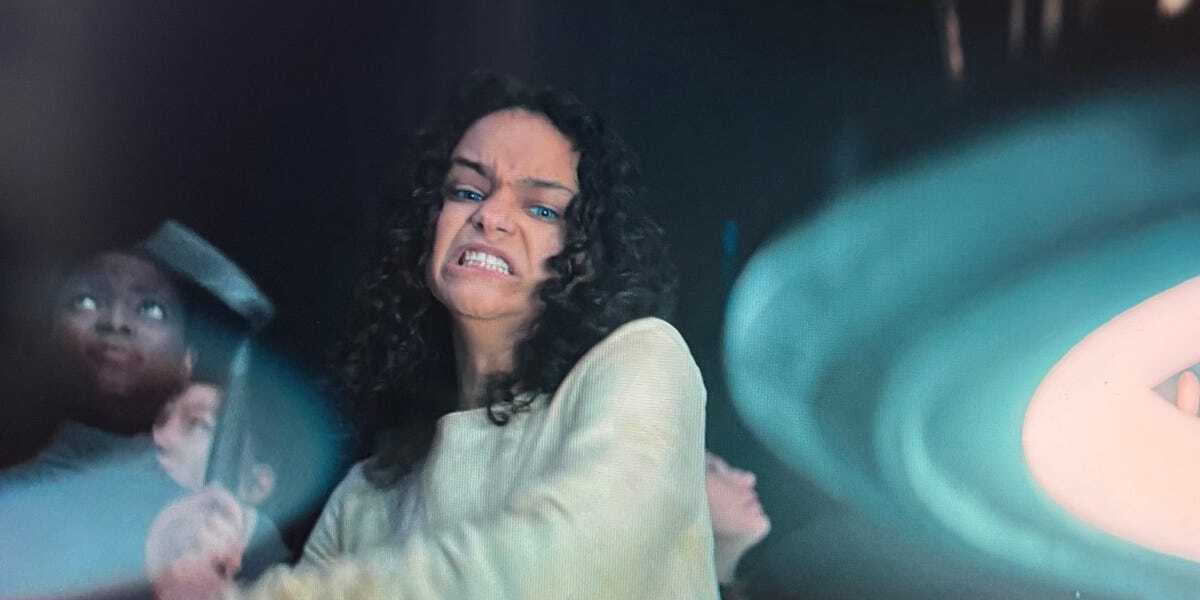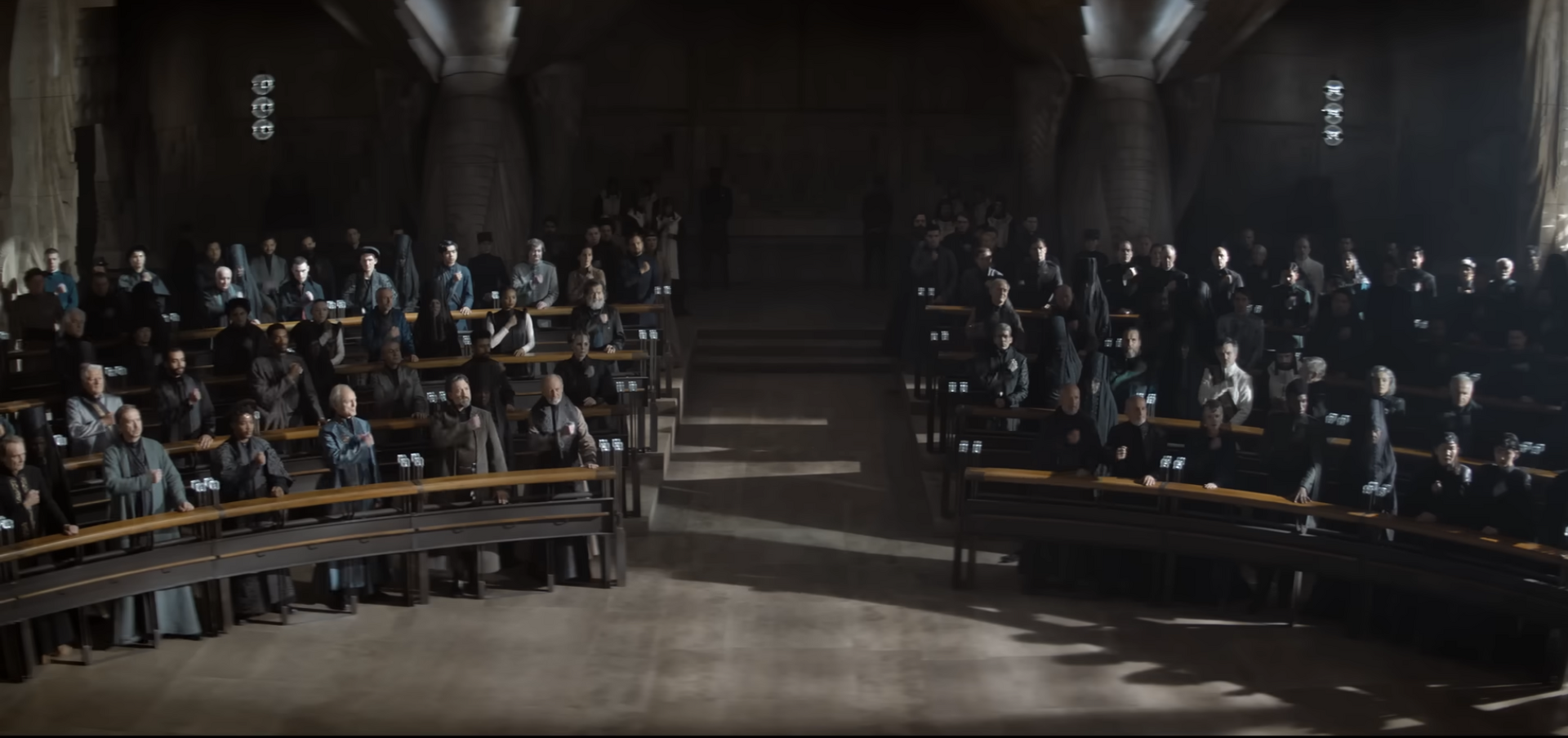
A couple of months ago we talked about the Faufreluches, the rigid caste system of the Imperium. As part of that, we obviously mentioned nobility and the Houses both Major and Minor, but we never got into who they are.
Yes, we all know about the Atreides, the Harkonnen and the Corrino families but what else was there? With the expanded universe, the HBO series and the various video games I'm sure you can mention a few more Houses - but are they part of the Core Canon, straight from the pen of Frank Herbert?
I went through the six original books to find us some answers.
We know that there's two types: major and minor.
HOUSE: idiomatic for Ruling Clan of a planet or planetary system.
HOUSES MAJOR: holders of planetary fiefs; interplanetary entrepreneurs. (See House above.)
HOUSES MINOR: planet-bound entrepreneur class (Galach: "Richece").
— Terminology of the Imperium, Dune [1965]
Basically, if you ruled over a planet and had business interests spanning multiple star systems, you made the cut and were considered a major House.
But obviously there's a further distinction: while all Great Houses had shares in CHOAM, the most powerful houses had Directorships in the company and had thus direct influence over the economy of the Known Universe.
The Duke noted his son's distress, said: "As always, Hawat sees the main chance. But there's much more. I see also the Combine Honnete Ober Advancer Mercantiles—the CHOAM Company. By giving me Arrakis, His Majesty is forced to give us a CHOAM directorship … a subtle gain."
"CHOAM controls the spice," Paul said.
"Few products escape the CHOAM touch," the Duke said. "Logs, donkeys, horses, cows, lumber, dung, sharks, whale fur—the most prosaic and the most exotic … even our poor pundi rice from Caladan. Anything the Guild will transport, the art forms of Ecaz, the machines of Richesse and Ix. But all fades before melange. A handful of spice will buy a home on Tupile. It cannot be manufactured, it must be mined on Arrakis. It is unique and it has true geriatric properties."
— Dune [1965]
If you want to learn more about CHOAM, I can only recommend this Summer School edition of the Dune Minute Podcast.
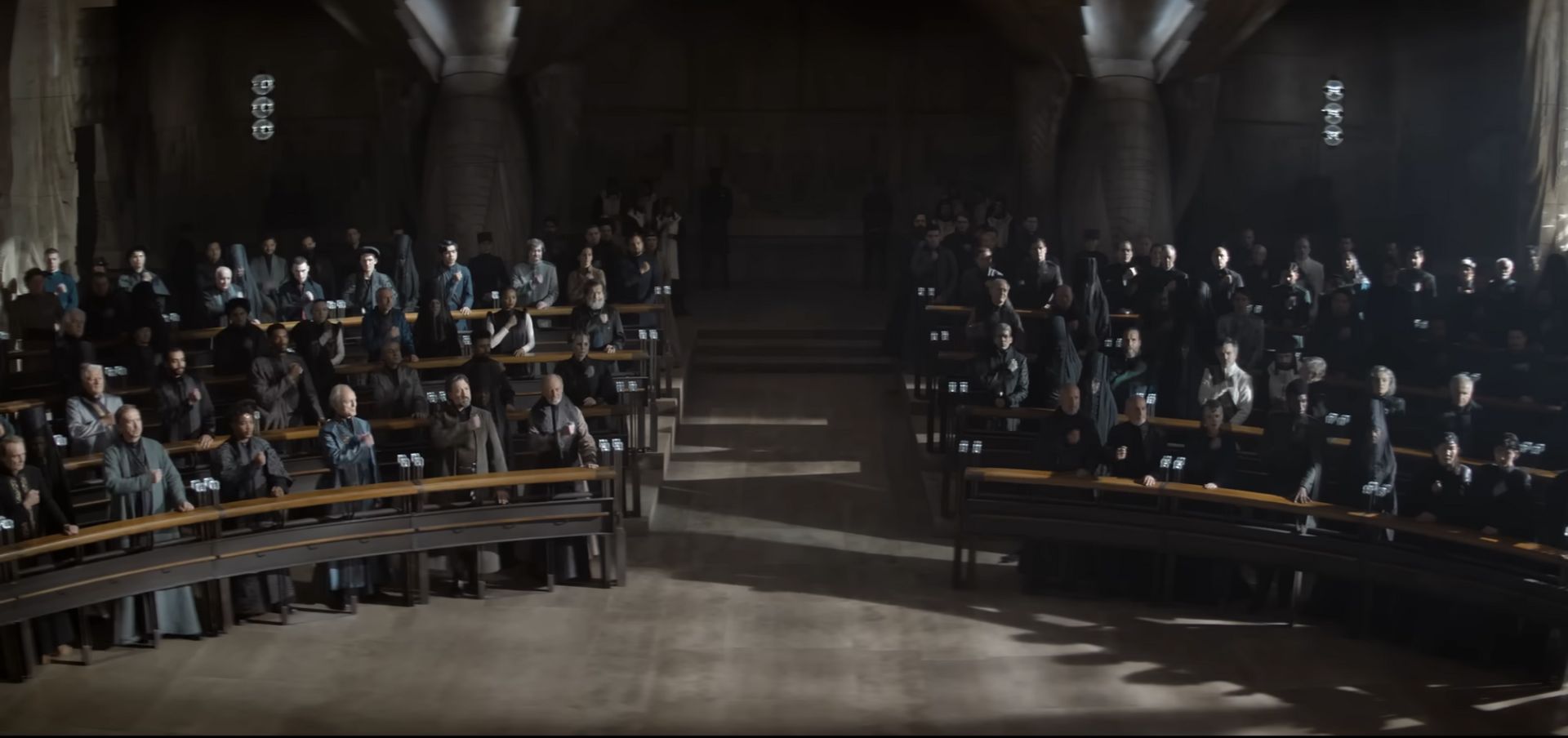
Just like in the feudalistic societies on Earth, the nobles who received planetary fiefs from the Emperor banded together to form an institution like the English Parliament or the French Estates-General.
Its primary function was to serve as a political and military counterbalance to the power of the Padishah Emperor. It also provided a general forum where Houses could forge alliances, make trade agreements, or declare formal feuds.
But just like with CHOAM, the real power is much more concentrated - in the case of the Laandsraad, it's the High Council.
HIGH COUNCIL: the Landsraad inner circle empowered to act as supreme tribunal in House to House disputes.
— Terminology of the Imperium, Dune [1965]
This executive body of the Landsraad did a lot of governing:
But of course, the balance of power was upset (to say the least) by Muad'Dib and especially by Leto II (the second) - we learn from a Bene Gesserit report that by the end of the God Emperor's rule there are basically no Houses Major left.
Thirty-one former Great Houses suffered economic disaster in this reporting period. Only six managed to maintain House Minor status. (See attached list.) This continues the general trend noted over the past thousand years where the once Great Houses melt gradually into the background. It is to be noted that the six who averted total disaster were all heavy investors in CHOAM and that five of these six were deeply involved in the Star Jewel project. The lone exception held a diversified portfolio, including a substantial investment in antique whale fur from Caladan.
— God Emperor of Dune [1981]
I won't spend too much time on the obvious, but for the sake of completeness, let's go check off the main three.
House Atreides stands as the archetypal Great House - twenty-six generations ruling Caladan before their fateful move to Arrakis. As we've seen from the previous quote, while they're an influential House Major, they don't have a CHOAM directorship and I'd assume they're not part of the High Council.
House Harkonnen represented the opposite approach: political power through and economic dominance. In the expended universe this point is further developed to hint at the Harkonnen's "buying" their noble title rather than earning it.
House Corrino, named after the Battle of Corrin in 88BG and ruling as the Padishah Emperors of the Known Universe for ten millennia.
But who else is there?
You might've thought of it as a place where Swordmasters are being trained, but canonically it's House Ginaz.
GINAZ, HOUSE OF: one-time allies of Duke Leto Atreides. They were defeated in the War of Assassins with Grumman.
— Terminology of the Imperium, Dune [1965]
And speaking of Grumman, that's a planet ruled by House Moritani.
GRUMMAN: second planet of Niushe, noted chiefly for the feud of its ruling House (Moritani) with House Ginaz.
— Terminology of the Imperium, Dune [1965]
And last but not least, we have a throw-away comment about House Metulli, whose financial troubles forced them to sell off half their planet, at the very beginning of Leto II (the second) rule.
Leto's personal estimate was that spice production would fall soon to a stabilized one-tenth of its peak in the Harkonnen years. Stockpiles throughout the empire doubled in value at every new posting. Three hundred and twenty-one liters were said to have bought half of Novebruns Planet from the Metulli Family.
— Children of Dune [1976]
And - as far as I could find - that's it: a total of six named Houses Major in the core canon.
If you were looking for the likes of Ecaz and Richese, they're only ever mentioned as a planets, just like Ix.
When it comes to the Houses Minor, we have even less. Only one, by my count. Which of course, makes sense - they're extras in the grand play of the Great Houses.
We get plenty of general descriptions both on Arrakis,
There was Paul in the corner surrounded by a fawning group of the younger Arrakeen richece, and, aloof among them, three officers of the House Troop. The Duke took particular note of the young women. What a catch a ducal heir would make. But Paul was treating all equally with an air of reserved nobility.
— Dune [1965]
and Geidi Prime.
The Baron noted how all conversation among the Houses Minor there stopped at her approach, how the eyes followed her. Bene Gesserit! the Baron thought. The universe would be better rid of them all!
— Dune [1965]
But the only actual name-drop happens under Alia's regency: House Nebiros.
Her temple guards had brought her a prisoner to judge at sunset the previous day: one Essas Paymon, a dark little man ostensibly in the pay of a house minor, the Nebiros, who traded in holy artifacts and small manufactured items for decoration
— Children of Dune [1976]
I only have a single example of someone who doesn't seem to fit either of these molds: Count Fenring.
The expanded sources make him out to be a descendant of a House Minor, rising to greater power with the ascension of Shaddam IV, but the core canon puts him in a weird spot.
He's a Count, a title that should mean he's the leader of a House Major, but he doesn't have a fief - we see him operate as an agent of the Emperor on Arrakis, and once the Atreides arrive on Arrakis, he gets a temp job on Caladan. And once Muad'Dib took power, he hung out with Shaddam.
The Imperial chores carried out by Count Fenring included that of Imperial Agent on Arrakis during the Harkonnen regime there and later Siridar-Absentia of Caladan. He joined Shaddam IV in retirement on Salusa Secundus.
— The Almanak en-Ashraf, Dune [1965]

.svg.png)
.png)

If you wanna chat, find me on BlueSky.
Even if you're not a supporter (yet), you can get new articles as an email as soon as they're published - full length for free stuff and a preview of the premium content.


_01460.jpg)